Practice
The 5-4-3-2-1 grounding technique explained, step by step
The 5-4-3-2-1 grounding technique explained: the five steps, why naming what your senses notice helps in panic or a flashback, and quiet versions for public.

The 5-4-3-2-1 technique is a grounding exercise: you notice five things you can see, four you can feel, three you can hear, two you can smell and one you can taste. Working through your senses gives an overwhelmed mind a concrete task in the present, which can loosen the grip of panic, racing thoughts or a flashback. It takes one to three minutes and can be done silently anywhere.
Key takeaways
- The numbers are a scaffold, not a test. Noticing three things you see instead of five still counts.
- Detail is the active ingredient: the texture of a sleeve or the hum of a fridge works better than a quick list.
- It tends to work best when you start early, as distress begins to build, rather than at its peak.
- No trial has tested 5-4-3-2-1 on its own; it comes from clinical practice and is used widely by therapists and NHS services.
When anxiety spikes, your attention narrows and turns inwards. You start tracking your heartbeat, replaying a conversation, or bracing for something that has not happened. Telling yourself to “stay present” rarely works, because it is not clear what to do with that instruction.
The 5-4-3-2-1 technique turns “stay present” into a short, concrete task. It is one of the most widely taught grounding exercises, and it needs nothing but your own senses. Here is how to do it well, why it can help, how to adapt it, and what the evidence does and does not say.
The five steps
Before you start, take one or two slow breaths. The University of Rochester Medical Center suggests finding your breath first, then working down through the senses.
- Five things you can see. Pick out details, not just objects: the scuff on a shoe, the way light falls across a table, the colour of a lanyard.
- Four things you can feel. Your feet in your shoes, the seam of your jeans, the weight of your phone, the air on your face.
- Three things you can hear. Sounds outside your own body: traffic, a fridge, someone typing two desks away.
- Two things you can smell. Coffee, hand soap, rain, your own jumper. If nothing comes, move to find a scent.
- One thing you can taste. Toothpaste, your last drink, or simply the taste of your mouth.
Say each item in your head, or out loud if you are alone. Take your time with each one. The whole round usually takes one to three minutes, and you can repeat it.
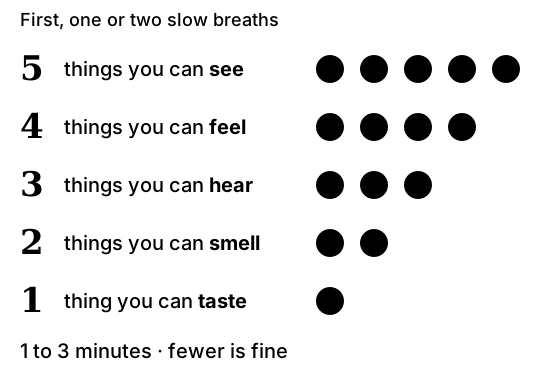
The Cleveland Clinic stresses that the numbers are a loose framework. If you only manage three things you can see, carry on to touch. Perfection is not the goal.
Why naming what you sense can help
Anxiety mostly lives in the future (“what if…”) or the past (“why did I…”). Your senses only work in the present. Asking them for specific information pulls attention back to where you actually are, and gives a racing mind a task with clear edges.
Picture Sofia on a crowded train when a wave of panic starts. Her thoughts are on her pounding heart and whether she will faint. Making herself find five things she can see (a red umbrella, a child’s trainers, an advert for paint, the scratched window, a man’s green scarf) does not stop her heart from pounding. It does give her mind somewhere else to be while the surge passes, and it interrupts the loop of checking her body for danger.
Grounding has a particular role with trauma. A clinical psychology leaflet from Hull University Teaching Hospitals NHS Trust explains that trauma memories are often re-experienced through all five senses, which can make it feel as if you are back in the event. Using the same senses to register the present helps remind you that you are here and safe. The leaflet describes grounding as particularly helpful for dissociation, flashbacks and nightmares.
Imagine Tom, who was in a car crash last year and sometimes freezes when he hears brakes screech. Feeling the cold metal of a railing, hearing a bus announcement, smelling a nearby bakery: each one is evidence that this is a different street on a different day.
When to use it
The best time is early, as distress starts to rise. The Cleveland Clinic notes that it is easier to calm down from a lower level of distress than from the peak. Grounding is still worth trying in a full panic attack, but expect it to take longer and to soften the experience rather than switch it off.
Good moments include:
- the first flutter of panic in a shop, lift or meeting
- after a nightmare, sitting on the edge of the bed
- when you notice you have been mentally rehearsing an argument for twenty minutes
- in the waiting room before an appointment that frightens you
NHS inform pairs the 5-4-3-2-1 exercise with slow belly breathing, and the two work well together: breathe slowly first, then ground.
Variations for different situations
Silently, in public
Nobody can tell you are doing it. Let your eyes rest on objects rather than darting around, press your fingertips gently into your palm or your thighs for the touch step, and count items on your fingers inside a pocket if you lose track.
Priya uses it in the queue at the post office when her chest starts to tighten: the grain of the counter, the beep of the card machine, the smell of printer paper. To anyone watching, she is just waiting her turn. If moments like this are frequent, our guide to understanding anxiety explains why anxiety builds and what helps beyond the moment.
With children
Turn it into a gentle game. Ask “Can you find five blue things?” or “What are three sounds you can hear right now?” and do it alongside them. Children often like choosing the categories themselves. Keep the tone curious rather than urgent, and practise when they are calm so it is familiar when they are upset.
With a carried object
The Hull leaflet suggests some people carry something that reminds them they are safe, such as a pebble or a stress ball, and that strong flavours like gum or sweets can make the taste step easier. A smooth stone in a coat pocket makes the “feel” step instant.
Shorter versions
When you have only seconds, do 3-2-1: three things you see, two you feel, one you hear. Or pick a single sense and go deep, describing one object in as much detail as you can.
What the evidence says, honestly
The 5-4-3-2-1 technique is a staple of therapy and NHS self-help materials, and it is taught by university health services and hospital psychology teams. What we could not find is a trial that tests it on its own against a control group. Its support comes from clinical experience and from the broader logic of attention-based coping, rather than from studies measuring this exact exercise.
That makes it a low-risk tool worth trying, not a proven treatment. If it helps you, use it. If it does not, there are other grounding approaches, such as focusing on breathing, cold water on your wrists or naming items in a category, and a therapist can help you find one that fits.
When grounding is not enough
If panic attacks, flashbacks or overwhelming anxiety keep coming back, or you find yourself avoiding places because of them, talk to a GP or mental health professional. Treatments such as trauma-focused therapy and CBT address the causes, while grounding only helps you through the moment. If you feel unsafe or are in crisis, go to our crisis help page now.
Practise it on a calm day
Like any skill, grounding is easier to use under pressure if you have done it when nothing was wrong. Try one slow round today, wherever you are reading this, and notice how much detail is around you that you had tuned out.
The wise move
Put a strong mint or a piece of gum in the pocket of the coat or bag you use most. It is your ready-made 'one thing you can taste' for the next time you need to ground yourself.
Questions people ask
What if I cannot smell or taste anything?
That is common, especially indoors. Notice the absence, move to find a scent such as soap or coffee, or swap the last two steps for something else you can feel. The aim is attention to the present, not a complete set.
Can grounding make things worse?
Occasionally a sound or smell is linked to a bad memory and pulls you further in. If that happens, switch to a different sense, such as pressing your feet into the floor or holding something cold, and work out with a therapist which anchors feel safe.
Should I close my eyes?
Usually not. Keeping your eyes open helps you register where you are now, which is the whole point. If you are somewhere you feel safe and prefer eyes closed, start with sounds and touch instead of sight.
Sources
- 5-4-3-2-1 Coping Technique for Anxiety — University of Rochester Medical Center, Behavioral Health Partners, 2018
- Grounding: 5-4-3-2-1 (Cancer Psychology Service leaflet) — Hull University Teaching Hospitals NHS Trust, 2020
- Grounding exercises — NHS inform (NHS 24, Scotland), 2025
- A Step-by-Step Look at the 5-4-3-2-1 Grounding Technique — Cleveland Clinic, 2026
This article is general information, not medical advice. Talk to a doctor or qualified professional about your own situation. Read how we work in our editorial standards.
Keep moving
More in Mind →
Anxiety: what it is, what helps, and when to get support
A calm, evidence-based guide to anxiety: why it happens, how ordinary worry differs from an anxiety disorder, what helps day to day, and when to seek support.
How to calm down fast: breathing techniques that work
Three simple breathing techniques you can use in minutes when stress spikes, what the research actually shows, and how to make them part of your day.

The dichotomy of control: stop worrying about what you can't change
Epictetus's oldest piece of advice, explained: how to sort what is up to you from what is not, why it eases worry, and what modern research adds.