Practice
How to build a reading habit as an adult: small pages, steady cues
Used to love books but now barely finish one a year? A practical plan to build a reading habit as an adult: a tiny daily dose, a fixed cue and less friction.
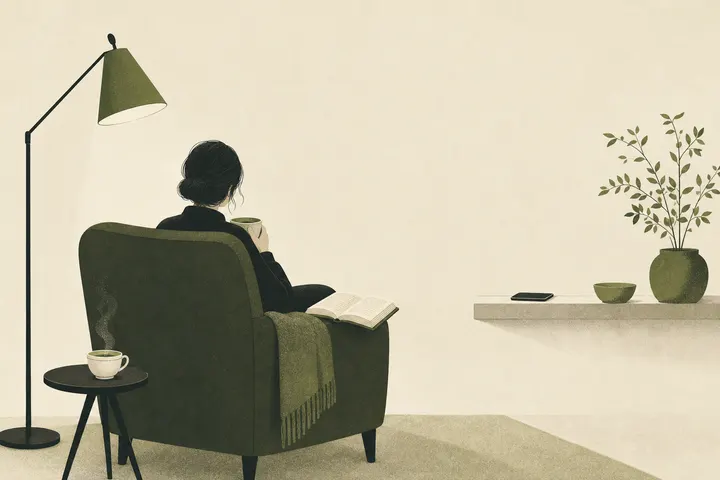
Pick a daily dose so small it feels almost silly, such as ten pages or ten minutes, and attach it to a moment that already happens every day, like getting into bed or sitting down on the train. Keep the book where that moment happens and the phone somewhere else. Audiobooks count, and so does abandoning a book you are not enjoying.
Key takeaways
- A reading slump is usually a cue problem, not a character flaw: the old reading moments got taken over by screens.
- The book should be physically in the place where your cue happens, before the phone is.
- In one small experiment, people understood a non-fiction chapter about equally well whether they read it or listened to it.
- Stopping a book that bores you protects the habit; forcing yourself through it often ends the habit instead.
- Book reading is linked with longer life in one large study, but that is an association, not proof that reading causes it.
Plenty of adults remember being a child who read under the covers and now cannot recall the last book they finished. The love of reading did not disappear. The moments that used to hold reading, the bus ride, the quiet half hour before sleep, the wait at the dentist, have quietly been filled by a phone.
That is good news, because it means the fix is practical. You do not need more willpower or a 52-book challenge. You need a small dose, a reliable cue, and a little less friction between you and the page.
Start with a dose you cannot fail
Ambitious reading goals tend to work for about a week. The habit that lasts usually starts embarrassingly small: ten pages, ten minutes, or one chapter of a short book.
Small is not a compromise. Habit researchers note that simpler actions become habitual more quickly than complex ones (British Journal of General Practice, 2012), and the same article explains that automaticity builds through repetition in a stable context. Why that works is explained in our guide to how habits form; for reading, it means showing up daily matters more than the page count on any given day.
Hannah, a primary school teacher, set herself an hour a night in January and stopped by the second week, too tired after marking. In February she tried ten pages. Most nights she read more than ten, because once she had started, carrying on was easy. On the nights she stopped at ten, she still counted it.
Give reading a fixed moment
Reading “when I have time” rarely happens, because the phone always has time first. Pick one moment that already occurs every day and write a plan for it:
- “When I get into bed, I will read ten pages before I check anything.”
- “When I sit down on the train, I will open my book before my phone.”
- “After I finish eating lunch, I will read until my break ends.”
- “When the children’s bath is running, I will read at the kitchen table.”
Plans like these, which name when and where you will act, are called implementation intentions. A meta-analysis pooling 94 independent tests found they had a medium-to-large effect on reaching goals (Gollwitzer & Sheeran, 2006).
Bedtime is the most common choice and the most contested, because the phone is right there too. If that is your battleground, our plan for how to stop scrolling in bed pairs well with a bedtime book.
Make the book easier to reach than the phone
The habit loses most often in the first few seconds, when your hand chooses what to pick up. Change what is within reach.
- Leave the book in the place where your cue happens. On the pillow, in the bag pocket you open on the train, on the table where you eat lunch.
- Put the phone somewhere slightly inconvenient at your reading moment: across the room, in a coat pocket, charging in the hall.
- Keep the next book ready. The gap between finishing one book and choosing another is where many reading habits stall. A short list of books you want to read closes that gap.
- Use a bookmark you can see. A visible bookmark halfway through is a small reminder that you are in the middle of something.
Rafael, a software developer, kept a paperback in his laptop bag for months without opening it, because his phone was in his hand before he reached his seat. He moved the phone to the bag and the book to his jacket pocket. The swap took ten seconds and the train became his reading time.
What counts as reading
Adults returning to books often set themselves a strict definition of reading and then fail it. Be generous.
Audiobooks count. In a small experiment, Beth Rogowsky and colleagues randomly assigned 91 adults to listen to, read on screen, or both read and listen to the same non-fiction chapter. Comprehension was about the same across the three groups, both straight away and two weeks later (SAGE Open, 2016). It was one chapter, one study and on-screen reading rather than paper, so it does not settle the question for every kind of book, but it is a fair reason not to dismiss listening.
Short stories, graphic novels, poetry, long magazine features and books you loved at fifteen all count too. A reading habit is built on enjoyment; prestige can come later, if you want it.
Give yourself permission to quit a book
Nothing stalls a reading habit like a book you dread. You stop reading it, but you do not let yourself start another, so you stop reading altogether.
Set a simple rule in advance, such as: if I have read three or four chapters and still do not want to pick it up, I stop and choose something else. Joan, a retired nurse, abandoned a much-praised novel after fifty pages, picked up a detective series she had always meant to try, and read six books in two months. Putting a book down is a decision about one book, not about you as a reader.
Why it may be worth the effort
People usually return to reading for pleasure, but there is an intriguing finding on health too. Bavishi and colleagues looked at 3,635 adults aged 50 and over in the US Health and Retirement Study. After adjusting for factors such as age, education, health and wealth, book readers had about a 20% lower risk of dying over the follow-up period than non-readers, and the link was explained largely by cognitive ability (Social Science & Medicine, 2016). The authors note that book readers averaged roughly half an hour a day, a chapter a day.
This is an observational study based on self-reported reading, so it cannot show that reading causes longer life; readers may differ from non-readers in ways the researchers could not measure. It is a reason for interest, not a promise.
Keep score kindly
A simple list of books finished, or a tick for each day you read your minimum, is enough tracking. Count days rather than books for the first couple of months, so a long or difficult book does not make you look like you have stopped. When a busy week breaks the run, go back to your ten pages at the next cue, with whatever book currently makes you curious.
The wise move
Choose the book you are most curious about right now, not the one you feel you should read, and leave it open face-down on your pillow tomorrow morning so it is waiting for you at bedtime.
Questions people ask
Do e-readers count, or do I need paper books?
Either works for a habit. An e-reader can be easier to carry and has no social media on it, while a paper book on the bedside table is a stronger visual cue. Choose the format you will actually pick up.
How many books a year should I aim for?
Annual book counts tend to push people towards short books and away from the ones they want to read. A daily dose is easier to control, and the yearly number follows from it.
I fall asleep after two pages in bed. What should I do?
That is a sign the bedtime cue suits sleep better than reading. Keep a page or two there if you like it, and move your main reading to a more alert moment, such as lunch or the journey to work.
Sources
- A chapter a day: Association of book reading with longevity — Social Science & Medicine (Bavishi, Slade & Levy), via PubMed Central, 2016
- Does Modality Matter? The Effects of Reading, Listening, and Dual Modality on Comprehension — SAGE Open (Rogowsky, Calhoun & Tallal), abstract via RePEc/IDEAS, 2016
- Making health habitual: the psychology of 'habit-formation' and general practice — British Journal of General Practice (Gardner, Lally & Wardle), 2012
- Implementation intentions and goal achievement: A meta-analysis of effects and processes — Advances in Experimental Social Psychology (Gollwitzer & Sheeran), 2006
Read how we work in our editorial standards.
Keep moving
More in Habits →
How habits really form (and why "21 days" is a myth)
What research says about how long a new habit takes, why context cues matter more than willpower, and how to make a good habit stick for good.

How to stop scrolling in bed: why it happens and a plan for tonight
Why the phone keeps you up long after you meant to sleep, what the research on bedtime phone use shows, and a practical habit plan to stop scrolling in bed.
The two-minute start: beating procrastination with tiny actions
Procrastination is mostly about avoiding bad feelings, not laziness. A simple practice: shrink the first step, start for two minutes, and forgive the delay.