Practice
How to calm down before a job interview: a timeline that works
How to calm down before a job interview, from the night before to the first question: preparation that lowers nerves, a quick breathing reset and an excitement reframe.
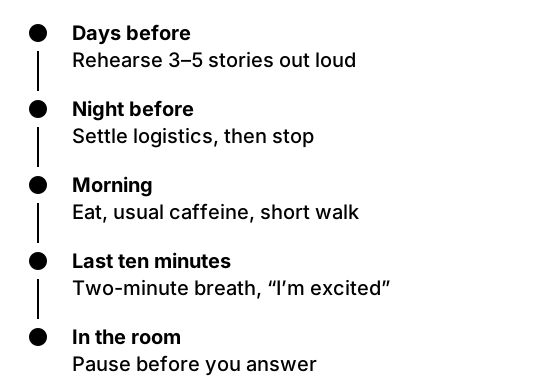
Prepare so there is less to fear, then aim to channel your nerves rather than erase them. The night before, settle logistics and rehearse three stories out loud. In the last ten minutes, slow your breathing with long exhales and tell yourself 'I'm excited', which in experiments helped people perform better than trying to calm down. In the room, pause before answering and take each question on its own.
Key takeaways
- Interview nerves are common and only modestly linked to how well you come across, so feeling anxious does not mean you will do badly.
- Many interview fears are about finding examples on the spot, which is the part preparation fixes best.
- Calling the feeling excitement worked better than trying to calm down in experiments on public speaking and maths tests.
- A two-minute breathing reset is enough before you walk in; save longer practice for the days before.
You have the interview on your calendar, and with it comes a familiar set of symptoms: a tight stomach, a mind that keeps rehearsing worst cases, and a fear that your voice will shake the moment someone says “So, tell us about yourself.”
Interview nerves are normal, and the goal is not to feel nothing. It is to keep the nerves at a level where you can think, remember your examples and sound like yourself. The plan below works backwards from the interview itself, with something useful to do at each stage.
First, what nerves do and do not predict
Researchers at the University of Guelph and the University of Ottawa have studied interview anxiety in detail. In a conference presentation summarising their work, Deborah Powell and Silvia Bonaccio report that across about thirty studies, people who felt more anxious did tend to be rated a little lower by interviewers, but the link was modest. In their own sample of people applying for residence assistant posts, interview anxiety had essentially no link with how well those who were hired later did the job.
Two things follow. Your nerves are not a sign that you are unsuited to the role. And the gap between how you feel and how you come across is smaller than it seems from the inside.
The same presentation lists lack of preparation among the causes of interview anxiety, and the most common worry interviewees described was communication: struggling to think of a good example, losing the thread, rambling. That is where to start.
The days before: prepare the part that frightens you
Preparation is the most reliable way to lower interview anxiety, because it removes some of the uncertainty your brain is reacting to.
- Choose three to five stories from your work, studies or life that show a problem you solved, a conflict you handled and something you learned from a mistake. Most behavioural questions can be answered with one of them.
- Rehearse them out loud, not just in your head. Saying an answer reveals where it wanders. Recording it on your phone shows you filler words and how long you really talk.
- Practise short. Aim for answers of about one to two minutes. Shorter answers are easier to remember under pressure.
Take Mei, applying for her first team-leader role. She feared being asked about a time she managed conflict and freezing. She wrote down one real example, said it out loud five times over two evenings, and on the day it came out almost word for word. The fear did not vanish, but the thing she was afraid of no longer happened.
If you find yourself putting off preparation because it makes you anxious, our guide to beating procrastination has ways to make that first ten minutes easier to start.
The night before: close the open loops
Uncertainty fuels worry, so use the evening to settle practical questions:
- Lay out what you will wear and check it fits and is comfortable.
- Confirm the address, route and journey time, or test your camera, microphone and link for a video interview.
- Write the interviewer’s name and two questions you want to ask them.
- Then stop preparing. Last-minute cramming tends to raise anxiety rather than knowledge.
Sleep may be patchy, and that is fine; one restless night will not sink you. If worry keeps you awake, getting the to-do list out of your head and onto paper helps many people, and our guide on how to sleep better has more.
The morning: steady body, steady mind
Eat something, even if your appetite is low. Keep caffeine to your usual amount. If you can, get a short walk outside; moving gives restless energy somewhere to go.
Avoid scrolling job forums or reading horror stories about interviews. Instead, skim your three stories once and leave them.
The last ten minutes: breathe, then get excited
A two-minute breathing reset
Find a quiet corner, a bathroom or a seat in your car. Breathe in gently through your nose and out slowly through your mouth, letting the out-breath be a little longer than the in-breath. The NHS breathing exercise uses a steady count of up to five in and five out; even two minutes can take the edge off a racing heart. If you want a technique to practise in the days before, our page on breathing to calm down compares several.
Call it excitement
This step can feel counterintuitive. Harvard researcher Alison Wood Brooks found that most people believe trying to calm down is the best way to handle pre-performance nerves. In a series of experiments involving karaoke, public speaking and maths tests, people who instead reappraised their anxiety as excitement, for example by saying “I am excited” out loud, felt more excited, adopted more of an opportunity mindset and performed better than those told to calm down.
The idea is that anxiety and excitement feel physically similar: fast heart, alert mind. Moving from “I’m anxious” to “I’m excited” is a smaller jump than moving to “I’m calm”. A related study of students preparing for a graduate admissions test found that being told arousal can improve performance led to higher maths scores, both in practice and on the real test months later.
These studies did not test job interviews specifically, so treat this as a promising tool rather than a guarantee. In practice: just before you go in, say to yourself, “I’m excited to tell them about my work.” It costs nothing to try.
Imagine Jonah, waiting outside a panel interview, his heart thumping. Instead of fighting it, he tells himself the thumping means he cares about this job and is ready for it. Nothing in his body changes, but the meaning he gives it does.
In the room
- Pause before you answer. A breath and a second to think looks composed, not hesitant.
- Take questions one at a time. If one answer goes badly, let it go and start the next one fresh. Interviewers rarely judge you on a single question.
- Plant your feet. Feeling the floor under you is a quick grounding cue if your mind starts racing.
- Use your notes. Glancing at a notepad with your two questions is normal and shows you prepared.
When nerves are more than nerves
Feeling anxious before an interview is ordinary. If anxiety stops you applying for jobs at all, causes panic attacks, or affects many other parts of your life, it is worth talking to a GP or mental health professional; talking therapies can help a great deal. If you are ever in crisis or feel unsafe, go to our crisis help page.
One rehearsal today
You do not need to master every step. Pick your hardest likely question, answer it out loud once today, and notice that you got through it. That single rehearsal is worth more than an hour of worrying about it.
The wise move
Tonight, record yourself answering 'Tell me about a time something went wrong at work' on your phone. Listen once, cut it to under two minutes, and record it again.
Questions people ask
Should I tell the interviewer I am nervous?
A brief, light mention can help if your nerves are obvious, for example 'I'm a bit nervous because I really want this role'. It reframes the nerves as interest. Do not dwell on it or apologise repeatedly.
Does caffeine before an interview make anxiety worse?
It can. Large amounts of caffeine can increase jitteriness and a racing heart in some people. If you are already prone to nerves, have your usual amount or less, not an extra double espresso on the way in.
What if my mind goes blank mid-answer?
Pause, breathe out, and say something like 'Let me take a moment to think of the best example.' Interviewers expect thinking time. Restating the question in your own words often brings the answer back.
Sources
- Get excited: reappraising pre-performance anxiety as excitement — Journal of Experimental Psychology: General (Brooks), 2014
- Turning the knots in your stomach into bows: Reappraising arousal improves performance on the GRE — Journal of Experimental Social Psychology (Jamieson et al.), 2010
- Understanding interview anxiety: causes, coping and consequences (conference presentation) — CERIC Cannexus (Powell & Bonaccio)
- Breathing exercises for stress — NHS, 2026
This article is general information, not medical advice. Talk to a doctor or qualified professional about your own situation. Read how we work in our editorial standards.
Keep moving
More in Mind →
How to calm down fast: breathing techniques that work
Three simple breathing techniques you can use in minutes when stress spikes, what the research actually shows, and how to make them part of your day.

How to sleep better: what the evidence actually supports
Calm, evidence-based guidance on sleeping better: how much you need, which habits matter most, what to do about caffeine and alcohol, and when to get help.
The two-minute start: beating procrastination with tiny actions
Procrastination is mostly about avoiding bad feelings, not laziness. A simple practice: shrink the first step, start for two minutes, and forgive the delay.