Practice
How to fall back asleep at 3am: a step-by-step for the moment itself
Awake at 3am and can't drift off again? Why middle-of-the-night waking happens, what to do in the first minutes, when to get up, and when it is insomnia.

Keep the clock out of sight, stay still and let your breathing slow for a while, and if you notice frustration building or it feels like more than about twenty minutes, get up. Sit somewhere dim doing something mildly enjoyable and go back to bed only when your eyelids feel heavy. Next morning, get up at your usual time rather than sleeping in.
Key takeaways
- Brief waking between sleep cycles is normal. The problem starts when you stay awake long enough to start worrying about it.
- Checking the time tends to feed worry and makes you feel you have been awake longer than you have.
- The 'twenty-minute rule' is a rough ceiling, not a stopwatch. Frustration is the better signal to get up.
- Out of bed, pick something pleasant and low-effort. Avoid food, exercise and anything that counts as work.
- Waking most nights for three months or more is long-term insomnia, and CBT-I is the recommended first treatment.
You surface in the dark, fully alert. The house is silent, the radiator ticks, and before you have decided anything your mind has already opened tomorrow’s to-do list. A minute later comes the second thought: if I do not get back to sleep now, the whole day is ruined.
That second thought is what turns an ordinary waking into a long one. This page is about the half hour after it: what is going on in your sleep at that hour, what to do in the first few minutes, when to get up and what to do once you are up. The daytime habits that make waking less likely, from caffeine to wake-up times, are covered in our guide to how to sleep better.
Why the small hours are an easy time to wake
Sleep is not one smooth descent. It runs in cycles of roughly 80 to 100 minutes, usually four to six a night, and you may wake briefly between them (NHLBI). Deep sleep is concentrated early in the night, and REM sleep, which is lighter and closer to waking, takes up more of the later cycles. By three or four in the morning you have usually banked most of your deep sleep, so the pressure keeping you under is weaker.
Most of these wakings pass unnoticed. Think of Priya, a nurse on day shifts, who sleeps soundly most nights and has no memory of turning over at 2.40. What is different on her bad nights is not the waking but what follows it: a stray thought about a patient handover, a jolt of alertness, and suddenly she is lying there doing sums about how many hours are left.
So the task at 3am is not to prevent waking. It is to keep a brief waking from becoming a wide-awake one.
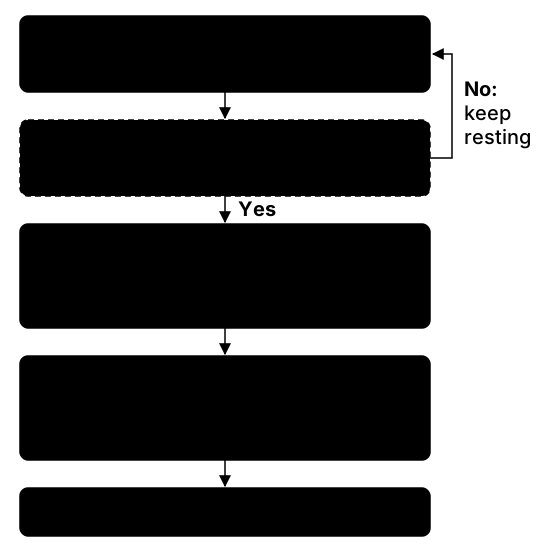
The first five minutes: do less, not more
Leave the clock alone. In a pair of experiments, Nicole Tang and colleagues asked people to either watch or ignore a clock while trying to fall asleep. Clock-watchers reported more worry before sleep and took longer to drop off, in good and poor sleepers alike. In people with insomnia, watching the clock also made them overestimate how long they had lain awake (Tang, Schmidt & Harvey, 2007). The study looked at falling asleep at bedtime rather than at night-time waking, but the mechanism is the same: the number on the screen starts a calculation, and the calculation keeps you up. A phone check is a clock check with notifications attached.
Stay still and let the body go first. Roll into your usual sleeping position, let your jaw and shoulders drop, and breathe a little more slowly than feels natural, with a longer out-breath. Our page on breathing to calm down has a few patterns to choose from. The aim is not to force sleep, which tends to backfire, but to stop adding effort.
Give the mind something dull to hold. If thoughts are racing, describe the room to yourself in detail, or walk through a familiar route in your head, street by street. Anything slow and neutral will do. If a genuine task surfaces, a notepad by the bed lets you write three words and let it go until morning.
When to get up, and why
If you are still awake and starting to feel tense, irritated or busy-minded, get out of bed. This is the core of stimulus control, a behavioural technique from insomnia treatment: the bed should be a cue for sleep, not for lying awake, so you leave it when you cannot sleep and come back when sleepy, as often as needed through the night (Journal of Behavioral and Cognitive Therapy, 2025).
You may have heard this called the 15- or 20-minute rule. The same 2025 review points out that the original instructions were deliberately vague about time, precisely so people would not watch the clock, and it advises estimating rather than checking. Treat “about twenty minutes” as a ceiling. Frustration is the more useful signal.
Take Tom, a teacher who wakes at 3.15 most Tuesdays with the week’s marking on his mind. He used to lie there for an hour “resting”. Now, once he notices himself drafting emails in his head, he gets up. Some nights he is back in bed within a quarter of an hour; on others it takes longer. Either way, the bed stops being the place where he rehearses Wednesday.
What to do once you are out of bed
Set this up in daylight so you do not have to think at 3am.
- Go somewhere else. Another room is best. If that is not possible, a chair in the corner of the bedroom will do.
- Keep the light low. A small lamp rather than the main light, and no bright screens.
- Sit upright, do not lie down. The 2025 review suggests sitting rather than reclining, partly so you notice sleepiness when it returns rather than nodding off on the sofa.
- Choose something mildly enjoyable. Counterintuitively, the review favours activities that pass the time pleasantly over deliberately boring ones: a familiar novel, a puzzle book, gentle music, a knitting project. Avoid eating, exercise and anything productive. Emptying the dishwasher or answering emails tells your brain the day has restarted.
- Go back when your eyelids are heavy. Not when a set time has passed, and not when you think you “should”. If you are awake again in bed and not settling, repeat.
Make it easier: if leaving the bedroom feels like too much, start by just sitting on the edge of the bed with a book and a reading light. Make it harder: keep a short note in the morning of roughly how often you got up. Patterns over a fortnight tell you more than any single night.
The morning after
The temptation after a broken night is to sleep in or go to bed early the next evening. Both tend to weaken the sleep pressure you need the following night. The NHS advises getting up at the same time every day and not sleeping in after a bad night (NHS). It feels harsh on the day; it is kinder to the night that follows.
Picture Grace, who runs a small bakery and treats every 3am waking as a reason to stay in bed until nine on her day off. The lie-in feels like repair, but it leaves her less sleepy at bedtime and more likely to wake again. Holding the alarm at seven, rough mornings included, is the less comfortable choice and the one the behavioural treatments are built on.
When 3am waking is insomnia
Waking in the night during a stressful week, or after a late drink, is common and usually passes. The NHS calls insomnia that lasts three months or longer long-term insomnia, and suggests seeing a GP if changing your habits has not helped, if you have had trouble sleeping for months, or if it is making daily life hard to cope with (NHS). Also mention to a doctor if you snore loudly, wake gasping, or feel low or anxious most days, since those can point to other causes.
The good news is that the main treatment works on exactly this problem. The American Academy of Sleep Medicine makes a strong recommendation for multicomponent cognitive behavioural therapy for insomnia (CBT-I) for adults with chronic insomnia, and also suggests stimulus control on its own as an option (Journal of Clinical Sleep Medicine, 2021). A meta-analysis of 20 trials found that CBT-I cut time awake after first falling asleep by roughly 26 minutes a night on average, with benefits that appeared to last (Annals of Internal Medicine, 2015). It is available face to face and through structured online programmes in many countries.
Until then, the 3am plan stays simple: no clock, stillness first, get up when frustration arrives, something pleasant in low light, and the same alarm in the morning.
The wise move
Before bed tonight, turn your clock to face the wall and set up a 'night chair' outside the bedroom: a dim lamp, a blanket and one easy book, so 3am has a place to go that is not your phone.
Questions people ask
Is it better to lie in bed resting with my eyes closed than to get up?
If you are calm and drifting, resting is fine. If you are lying there tense, planning or arguing with yourself, getting up usually works better, because it stops the bed becoming the place where you practise being awake.
Should I go to bed earlier to make up for 3am waking?
Usually not. Spending longer in bed tends to spread the same amount of sleep more thinly and can mean more time awake. Keeping a steady wake-up time is the more reliable fix.
Does it matter if I wake at exactly the same time every night?
Many people notice a regular waking time, often because of habit, a partner's alarm, light or noise at that hour. It is worth checking the room for a trigger, but the response is the same: no clock, get up if you are not settling.
Sources
- Stages of Sleep — National Heart, Lung, and Blood Institute (NIH)
- Sleeping with the enemy: Clock monitoring in the maintenance of insomnia — Journal of Behavior Therapy and Experimental Psychiatry (Tang, Schmidt & Harvey), 2007
- Implementation of Stimulus Control and Sleep Restriction Therapy for Insomnia: Standard Definitions and Best Practices — Journal of Behavioral and Cognitive Therapy (Cuddihy et al.), 2025
- Behavioral and psychological treatments for chronic insomnia disorder in adults: an American Academy of Sleep Medicine clinical practice guideline — Journal of Clinical Sleep Medicine (Edinger et al.), 2021
- Cognitive Behavioral Therapy for Chronic Insomnia: A Systematic Review and Meta-analysis — Annals of Internal Medicine (Trauer et al.), 2015
- Insomnia — NHS, 2024
This article is general information, not medical advice. Talk to a doctor or qualified professional about your own situation. Read how we work in our editorial standards.
Keep moving
More in Body →
How to sleep better: what the evidence actually supports
Calm, evidence-based guidance on sleeping better: how much you need, which habits matter most, what to do about caffeine and alcohol, and when to get help.
How to stop scrolling in bed: why it happens and a plan for tonight
Why the phone keeps you up long after you meant to sleep, what the research on bedtime phone use shows, and a practical habit plan to stop scrolling in bed.
How to calm down fast: breathing techniques that work
Three simple breathing techniques you can use in minutes when stress spikes, what the research actually shows, and how to make them part of your day.