Practice
How to make friends in your 30s after moving: a 3-month plan
Moved to a new city in your 30s and know nobody? Why adult friendship takes longer, what research says about the hours it needs, and a realistic three-month plan.

Choose one weekly activity where you will see the same people repeatedly, say yes to most reasonable invitations for the first month, and follow up with anyone you click with within a week by suggesting something specific in a different setting. After a couple of months, host something small yourself. Friendship in adulthood is built mostly from time spent together, so the plan is about creating regular hours, not about being more charming.
Key takeaways
- In a study of adults who had recently moved, more hours together went with closer friendships, especially leisure time.
- Time spent working side by side seems to count for less than time spent hanging out.
- After a first conversation, people tend to underestimate how much the other person liked them.
- Moving a contact into a new setting, such as coffee after the class, is the step most people skip.
- Hosting turns you from someone waiting for invitations into the person who creates them.
Marta moved across the country at thirty-three when her partner took a new job. Six months in, she knew the names of her neighbours’ dogs, two colleagues she liked, and the barista who remembered her order. What she did not have was anyone she could text on a Saturday morning to ask, “Walk?”
That gap is common, and it is not a sign that something is wrong with you. Adult life simply removes most of the conditions that used to make friends for you. The good news is that those conditions can be rebuilt on purpose. This page explains what they are and gives you a three-month plan.
Why it is harder now than at twenty
At school or university, friendship came bundled with three things: you were near the same people, you saw them over and over without planning it, and you had loose, unstructured time to fill. Most friendships grew out of that mix without anyone deciding to make friends.
In your thirties, after a move, all three tend to disappear at once. Your days run on work and home. Colleagues are near you but you mostly see them in task mode. Weekends fill with errands, a partner, perhaps children, and calls to the people you left behind. Nobody is bumping into you in a corridor five times a week.
Friendship runs on hours
Communication researcher Jeffrey Hall at the University of Kansas studied exactly this situation. In one part of his research, he surveyed 355 adults who had moved within the previous six months and were looking for friends, asking about people they had met since. More hours together went with closer friendships, and time spent on leisure activities together also predicted closeness (Journal of Social and Personal Relationships, 2019).
The university’s summary of the work gives rough figures: something like 40 to 60 hours to go from acquaintance to casual friend, about 80 to 100 hours to become friends, and more than 200 hours to become close friends. Hall also noted that hours spent working together counted for much less than time spent hanging out or joking around (KU News, 2018).
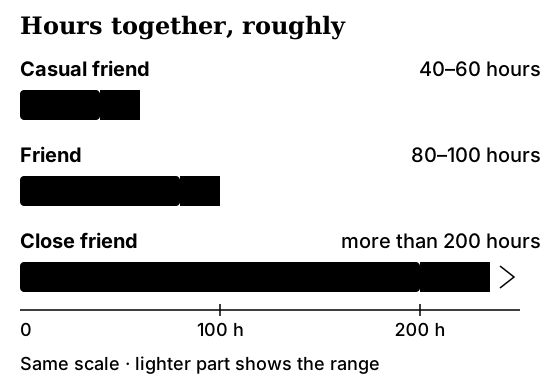
Take those numbers as a sense of scale, not a stopwatch. Their real lesson is that one great conversation is a start, not a friendship. Think of Dev, who has chatted pleasantly with the same colleague at the coffee machine for a year. They have spent plenty of time near each other, but almost none of it outside a work frame. One lunch somewhere else would likely do more than another month of coffee-machine talk.
You probably went down better than you think
There is a second obstacle, and it lives in your head. Psychologist Erica Boothby and colleagues found that after conversations, people systematically underestimated how much their conversation partner liked them and enjoyed their company. They called this the liking gap. It showed up between strangers in a lab, among people at a workshop, and among university students getting to know their new housemates, where it lasted for several months (Psychological Science, 2018).
That matters after a move because the liking gap quietly stops follow-ups. You leave the book group thinking you talked too much, so you do not suggest coffee. The other person leaves thinking the same about themselves. Nobody follows up, and both of you conclude the city is unfriendly.
A three-month plan
Month one: one recurring thing, and a month of yes
- Choose one activity that repeats weekly with the same people. A running club, a five-a-side team, a choir, a pottery course, a regular volunteer shift. Repetition is the point, so a one-off event or a drop-in where faces change each week is a weaker choice. Pick something you would enjoy even if you made no friends there.
- Say yes to most reasonable invitations. Colleague drinks, a neighbour’s barbecue, a friend-of-a-friend’s birthday. For this first month, decide in advance that “I’m tired” is not enough reason to stay home. You are collecting faces and names.
- Ask your existing network. Message a few friends and ask whether they know anyone in your new city. A warm introduction skips several awkward steps.
Month two: follow up within a week
-
Pick one or two people you clicked with and suggest something specific. Within a week of meeting them, while the conversation is still fresh, move the contact into a new setting. Hall’s advice was to change the setting of the relationship, for example by going for lunch with a colleague or a drink after an activity (KU News, 2018).
Something like: “I really enjoyed talking about hiking on Tuesday. I’m going to walk the reservoir loop on Sunday morning, around nine. Want to come?” A specific plan is easier to say yes to than “we should hang out sometime.”
-
Repeat with the same people. A second and third meeting matter more than meeting someone new. When you are with them, real attention helps; our guide on how to listen well has a simple routine.
Month three: become a host
- Host something small and repeatable. A soup night, a pub quiz team, a monthly walk with coffee at the end. Invite four to six people from different parts of your new life. Hosting does not need a big flat or cooking skills; it needs a time, a place and a message.
- Make it regular if it works. “Same time next month?” turns one evening into the kind of repeated, unplanned contact that school used to provide.
Make it easier: if three steps a month feels like too much, do only the first step of each month and stretch the plan to six months. Make it harder: add a second weekly activity in month two, so you have two separate circles growing at once.
Keep the long view
Three months will not give you close friends, and the research above suggests it should not be expected to. What it can give you is a handful of people you see regularly, one or two who are starting to become friends, and a routine that keeps adding hours without fresh willpower each week.
Loneliness during that stretch is normal, and it is worth taking seriously. Our guide to loneliness and health explains why connection matters so much and offers other ways to ease the gap. If low mood, poor sleep or withdrawal last for weeks and start affecting daily life, talk to a GP or a therapist; a move is a big life change, and asking for support during it is sensible, not dramatic.
The wise move
Before Friday, sign up for one activity that meets every week at the same time, and put the next eight sessions in your calendar now so each one is a default rather than a fresh decision.
Questions people ask
Are friend-finding apps worth trying in your 30s?
They can work as a way to meet people, but the same rule applies afterwards: a single coffee rarely becomes a friendship on its own. Treat an app match like someone from a class and aim for a second and third meeting soon after the first.
What if I'm an introvert and group activities drain me?
Pick small, structured groups where the activity carries the conversation, such as a climbing session, a choir section or a volunteer shift. Then put your energy into one-to-one follow-ups, which many introverts find easier than mingling.
Should I give up on my old friends back home to focus on new ones?
No. Old friendships are worth keeping on a lighter schedule, such as a monthly call. They provide support while the new ones are still thin, which can make you less anxious and easier company with new people.
Sources
- How many hours does it take to make a friend? (Hall) — Journal of Social and Personal Relationships, 2019
- How to make friends? Study reveals how many hours it takes — University of Kansas, KU News, 2018
- The liking gap in conversations: do people like us more than we think? (Boothby, Cooney, Sandstrom & Clark) — Psychological Science, 2018
Read how we work in our editorial standards.
Keep moving
More in Connection →
Loneliness is a health issue: small ways to reconnect
Loneliness affects about one in six people and is linked to heart disease, stroke and early death. What the evidence says, and small ways to reconnect.

How to listen well: the quiet skill behind good relationships
A simple, research-informed practice for listening well: how to give full attention, reflect back, ask good questions and hold back advice.

Why kindness is good for you: what research says
Does helping others make you happier? An honest look at the research on kindness and prosocial spending, including how large the effects really are.