Practice
How to stop hitting snooze: a wake-up plan that starts the night before
How to stop hitting snooze: what research says about snoozing, the usual reasons people do it, and a one-week plan built on alarm placement, a first action and a fixed wake time.
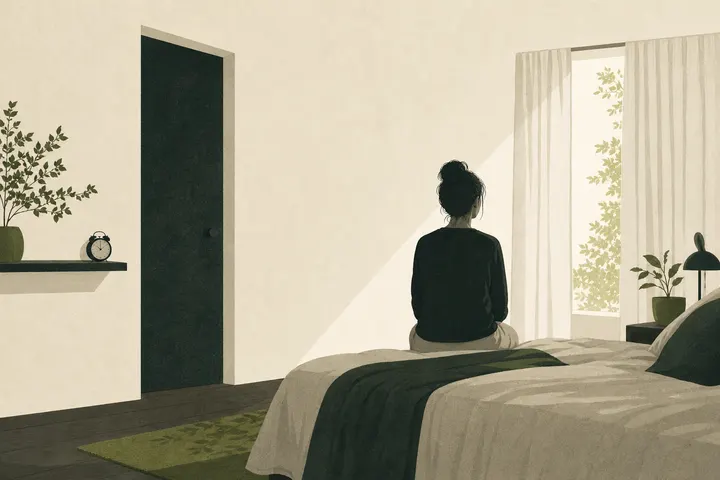
Set one alarm for the time you really need to get up, put it where you have to stand to switch it off, and decide in advance what your feet do next, such as walking to the window or the kettle. Keep that wake time every day of the week and move your bedtime, not the alarm, if mornings stay hard. If you keep snoozing after enough sleep, look at what the morning holds.
Key takeaways
- Snoozing is very common and research has not shown it to be clearly harmful; the case for stopping is about your morning, not your health.
- The snooze button wins because the cue, the reach and the reward are all in bed with you. Change the setup, not your character.
- Staggered 'just in case' alarms train you to ignore the first one.
- Grogginess after waking usually eases within about half an hour, so the first few minutes are the hardest part to plan for.
Priya sets her alarm for 6.30, then 6.39, then 6.48. She reaches for the phone each time without opening her eyes and finally gets up at 7.05, already late, skipping breakfast and promising herself that tomorrow will be different. Tomorrow is the same.
If that sounds familiar, you are not short of willpower. You are running a well-practised habit, and habits respond to changes in setup far better than to promises. This page explains what research says about snoozing, how to work out why you do it, and a one-week plan to stop.
Is snoozing actually bad for you?
Less than you may have heard. In a survey of 450 people, 57% snoozed, and snoozers did not sleep less or report more daytime sleepiness than non-snoozers, although they did show lighter sleep just before waking (Mattingly et al., 2022).
A Swedish team went further. Their survey of about 1,700 people found snoozing most common among younger people and night owls, and linked it to shorter sleep and morning drowsiness. In a lab study of 31 habitual snoozers, half an hour of snoozing cost about six minutes of sleep and did not harm, and sometimes slightly helped, thinking tests straight after rising (Sundelin et al., 2024). The samples are small, so this is not a licence to snooze for an hour. But it does mean the reasons to stop are practical: rushed mornings, a day that starts with a small defeat, and a partner woken three times.
What everyone experiences is sleep inertia, the groggy, slow-thinking spell after waking. A review found it often lifts within about 15 to 30 minutes, though full recovery can take an hour or more, and it is worse after too little sleep (Hilditch & McHill, 2019). That is the window the snooze button exploits: you are making a decision at the moment you are least able to make one.
Why the button keeps winning
Habits run on cues, routines and rewards, repeated in the same context until they no longer need a decision. Our guide to how habits form covers the mechanism. The snooze habit is a tight example of it: the cue (the alarm) is in bed with you, the routine (one thumb movement) costs nothing, and the reward (warmth, a few more minutes) arrives instantly.
Take Marcus, a nurse on early shifts, who keeps his phone on the pillow. He has never once decided to snooze. His hand does it before he is fully awake. No amount of resolve at 11pm reaches that hand at 5.30am, but moving the phone does.
Find your reason before you change the alarm
People snooze for different reasons, and the fix depends on which one is yours.
| What is going on | How you can tell | What to change |
|---|---|---|
| Not enough sleep | You need the alarm every day and sleep much longer at weekends | Move bedtime earlier, 15 minutes at a time |
| A late body clock | Wide awake at midnight, foggy until mid-morning | Fix your wake time, weekends included |
| “Just in case” alarms | Your first alarm is set well before you need to be up | One alarm, at the real time |
| The phone is the alarm | You reach it without sitting up | A separate alarm across the room |
| Nothing pulls you up | Mornings mean only rush or dread | One small thing you look forward to |
Most people have two of these at once, often the first and the fourth.
A one-week plan to stop hitting snooze
Night 1: one alarm, at the real time
Delete the staggered alarms. Work out the latest time you can get up and still have a calm morning, and set a single alarm for that. Staggered alarms teach you that the first ring does not count. One alarm, set honestly, means the first ring is the one that matters.
Also tonight: move it out of reach
Put the alarm where you must stand to turn it off: by the door, on a chest of drawers, on the floor of the hallway. If your phone is your alarm, use a cheap separate clock so the phone can stay out of the bedroom too.
Morning 1 onwards: decide what your feet do next
Standing up is the easy bit. Getting back into bed is the risk. Decide tonight what happens in the ten seconds after you switch the alarm off, and make it something that takes you away from the bed: open the curtains, walk to the kettle, step into the shower. Light and dark have the strongest influence on the body clock (NIGMS), so heading towards daylight is a good default. Our page of habit stacking examples for mornings has more chains to hang on that first step.
Leave a cue by the alarm: slippers, a dressing gown, a glass of water. It is easier to keep going when the next object is already in your hand.
Every day: the same wake time, weekends too
The CDC recommends going to bed and getting up at the same time every day (CDC). The wake time is the one to protect, because it anchors the rest. Many people find that a long weekend lie-in makes Monday’s alarm far harder to obey.
By the end of the week: set bedtime from the alarm
Adults aged 18 to 60 need seven or more hours of sleep a night, according to the CDC. Count back from your alarm and add time to fall asleep. If that bedtime looks unrealistic, move it earlier by 15 minutes every few nights rather than all at once. For the sleep side in more depth, see how to sleep better.
Make it easier: allow yourself one planned snooze with the alarm still across the room, so you have to stand up either way. Make it harder: once the new time is steady, use the first five minutes for one thing you have been meaning to start.
If you still snooze after a week
Look at the mornings that went wrong and ask what was different. Late screen time, a late meal or drink, a stressful day ahead? Jo, a teacher, noticed she only snoozed on Mondays and on days with a difficult class. The alarm was fine. The dread was the problem, and planning the hard lesson the evening before helped more than any clock.
If you are sleeping seven or more hours and still struggle to wake, it is worth taking seriously. The NHS suggests seeing a GP if you have felt tired for a few weeks without knowing why, if tiredness affects your daily life, or if someone has told you that you gasp, snort or choke in your sleep (NHS).
For most people, though, the snooze habit ends where it started: with where the alarm sits and what you do in the first ten seconds after it rings.
The wise move
Tonight, delete every alarm except one set for the time you must be up, put that alarm on the floor by the bedroom door, and leave your slippers or dressing gown next to it.
Questions people ask
Is it better to set the alarm later and skip the snooze?
Often, yes. If you routinely snooze for 20 minutes, those minutes are rarely restful. Setting the alarm for your real rising time gives you the same sleep in one piece and makes the first ring the one that counts.
Do sunrise alarm clocks help you stop snoozing?
They may make waking feel gentler, and light is the body clock's strongest signal. But one review found that light after waking improved how alert people felt without improving their test performance, so treat a light alarm as a nice extra, not a fix.
Why do I sleep through alarms completely?
Deep sleepiness at alarm time usually points to too little sleep or a body clock that runs late. If you sleep through loud alarms regularly, even after a full night, mention it to a doctor.
Sources
- Is snoozing losing? Why intermittent morning alarms are used and how they affect sleep, cognition, cortisol, and mood — Journal of Sleep Research (Sundelin, Landry & Axelsson), 2024
- Snoozing: an examination of a common method of waking — Sleep (Mattingly et al.), 2022
- Sleep inertia: current insights — Nature and Science of Sleep (Hilditch & McHill), 2019
- About Sleep — Centers for Disease Control and Prevention
- Circadian Rhythms — National Institute of General Medical Sciences (NIH)
- Tiredness and fatigue — NHS
Read how we work in our editorial standards.
Keep moving
More in Habits →
Habit stacking examples for mornings: 16 stacks for real routines
Sixteen ready-made morning habit stacks for parents, commuters, home workers and early starters, plus how to pick an anchor that does not wobble.
How to sleep better: what the evidence actually supports
Calm, evidence-based guidance on sleeping better: how much you need, which habits matter most, what to do about caffeine and alcohol, and when to get help.

How habits really form (and why "21 days" is a myth)
What research says about how long a new habit takes, why context cues matter more than willpower, and how to make a good habit stick for good.