Practice
How to stop overthinking at night: move the thinking to earlier
Why your mind replays and rehearses at bedtime, and how to stop overthinking at night with a scheduled worry time, a specific to-do list and a plan for in bed.

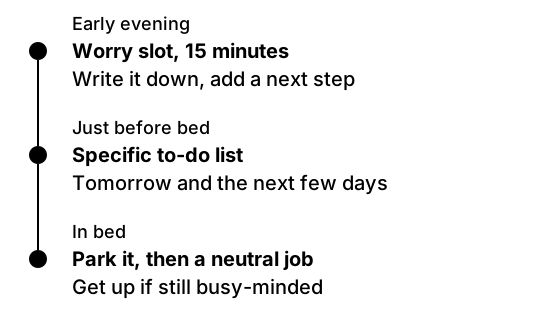
Give the thinking a better time and place than your pillow. Set aside fifteen minutes in the early evening to worry on paper, write a specific to-do list for tomorrow just before bed, and when a thought arrives in bed, tell yourself it has a slot tomorrow and turn your attention to something neutral. If you are still busy-minded after a while, get up until you feel sleepy.
Key takeaways
- Night-time overthinking is usually one of two things: rehearsing tomorrow or replaying today. Each needs a slightly different response.
- Postponing worry to a fixed slot sounds too simple, yet it has been tested in trials with people who worry a lot.
- A detailed to-do list for the next few days was linked to falling asleep faster than a list of jobs already done.
- Trying hard to stop a thought keeps it close. Redirecting attention works better than pushing the thought away.
The light goes off and your mind switches on. The conversation with your manager plays again, this time with the reply you should have given. Then a jump to the boiler service you have not booked, then to whether that mole has changed. Each thought is small. Together they keep you awake for an hour.
Night-time overthinking is not a sign that something is wrong with you. It is what a mind does when the day’s distractions stop and nothing has been decided about the things still open. The practices below move that thinking to a time when it can be useful, and give you something to do when it shows up in bed anyway.
Why the thoughts arrive at bedtime
During the day, attention is pulled outwards by conversations, screens and tasks. In a dark, quiet room, there is nothing left to compete with whatever is unresolved. Tiredness does not help: problems tend to look bigger and solutions further away when you are worn out.
Psychologists group repetitive negative thinking under the term perseverative cognition, which covers both worry (rehearsing what might go wrong) and rumination (going over what already happened). A meta-analysis pooling studies in people without a sleep or mental health diagnosis found that both were consistently linked to poorer sleep quality, shorter sleep and taking longer to fall asleep, with rumination slightly more strongly tied to sleep quality than worry (Health Psychology Review, 2020). Those are associations, so they do not prove which causes which, and in real life it probably runs both ways.
It helps to notice which kind you have. Daniel, a site engineer, mostly rehearses: tomorrow’s inspection, the crane booking, the email he has not sent. Aisha, a sixth-form student, mostly replays: what she said in the group chat, how her friend reacted. Rehearsing responds well to planning. Replaying responds better to setting a time limit and shifting attention.
Step one: a worry slot in the early evening
Choose a fixed fifteen minutes, ideally at least a couple of hours before bed and in the same place each day, such as at the kitchen table after dinner. During the slot, write down what is on your mind. For anything you can act on, add one small next step. For anything you cannot, write it down anyway and leave it there.
Outside the slot, when a worry turns up, note a keyword and tell yourself, “That goes in the slot.” This is worry postponement, and it has been studied for decades. In a 2024 randomised trial, adults with generalised anxiety disorder who learned worry postponement in just two sessions reported clearly less worry than a waiting-list group, and the effect held at a four-week follow-up (Clinical Psychology in Europe, 2024). One of its aims is to show people, through experience, that worry is more controllable than it feels.
Daniel’s slot is 7pm, ten minutes, on the back of an envelope. When the crane booking surfaces at 11pm, it already has a line and a next step written down. That makes it much easier to let it go.
Make it easier: start with five minutes. Make it harder: after a week, look back over the notes and mark the worries that actually happened. Most people find the list sobering in a good way.
Step two: a specific to-do list just before bed
The slot handles the heavy material. The last few minutes before bed are for something lighter and more practical: a list of what you need to do tomorrow and in the next few days.
In a sleep-lab study, 57 young adults spent five minutes before bed either writing a to-do list for the coming days or listing tasks they had already completed. The to-do group fell asleep faster, in about 16 minutes on average against about 25, and the more specific their lists, the faster they tended to drop off (Journal of Experimental Psychology: General, 2018). It was a single night in healthy young people, so treat it as a promising lead rather than settled science. The cost of trying it is five minutes and a pen.
Specific means “Email Jo the revised quote by 10am”, not “work stuff”. Write it on paper so the phone can stay out of the bedroom.
Step three: what to do when a thought arrives in bed
Thoughts will still turn up. The aim is not to stop them, which tends to keep them close, but to decline the invitation to follow them.
- Name it and park it. “Replaying the group chat. That can wait for tomorrow’s slot.” If it is a new task, add three words to the bedside notebook.
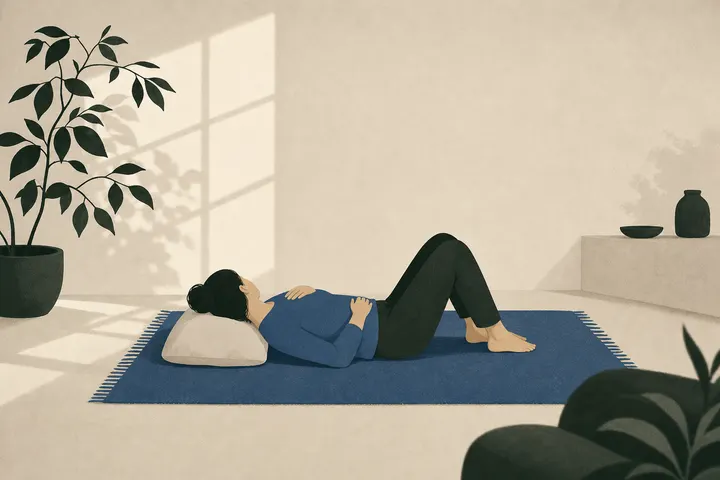
- Give your attention a neutral job. Slow breathing with a longer out-breath works for many people; our page on breathing to calm down has options. Others prefer a dull mental task, such as picturing each room of a childhood home in turn.
- Come back, gently, as often as needed. The mind will wander back to the worry. Each return to the neutral task is the practice, not a failure of it.
- Get up if you are still busy-minded. If you notice yourself getting frustrated or wide awake, sit somewhere dim with a calm book and return when sleepy. Lying in bed arguing with your thoughts teaches the bed to be the place for that argument.
Aisha finds that saying the parking sentence under her breath, then counting slow breaths backwards from fifty, gets her to sleep on most nights. On the nights it does not, she reads for a while on the landing.
When night-time worry is more than a busy mind
Overthinking at the end of a hard week is ordinary. It is worth looking at more closely if the worry spreads across many areas of life, feels hard to control most days, and comes with restlessness, tense muscles, tiredness or trouble sleeping. The US National Institute of Mental Health describes generalised anxiety disorder as difficulty controlling worry on most days for at least six months, alongside symptoms like these, and notes that cognitive behavioural therapy is a research-supported treatment (NIMH).
You do not need to wait six months to ask for help. If worry is affecting your sleep, work or relationships, a GP or psychologist is a sensible next step. Our guide to understanding anxiety explains how ordinary worry differs from an anxiety disorder and what treatment looks like.
If your thoughts at night turn to harming yourself, or you feel unable to keep yourself safe, contact your local emergency number or see our crisis help page for lines you can call now.
For most people, though, the fix is less dramatic: give the worrying its own time, give tomorrow a list, and give the night back to sleep.
The wise move
Set a daily phone reminder for 6.30pm called 'worry slot', and put a small notebook and pen on your bedside table tonight with tomorrow's date already written at the top of the first page.
Questions people ask
Is overthinking at night a sign of ADHD or depression?
It can come with many conditions, and with none at all. A racing mind on its own does not point to a diagnosis; what matters is the wider picture over weeks, which a GP or psychologist can help you sort out.
Does journaling about feelings at night help or make it worse?
It depends on the writing. Short, practical notes that close a loop tend to settle people. Long, open-ended writing about what is upsetting you can stir things up at bedtime, so it is often better done earlier in the evening.
What if my worry slot makes me more anxious?
Keep it short, write rather than think, and end it with one small next step for each worry you can act on. If the slot regularly leaves you shaken, that is useful information to bring to a professional.
Sources
- The association between worry and rumination with sleep in non-clinical populations: a systematic review and meta-analysis — Health Psychology Review (Clancy et al.), 2020
- Worry Postponement From the Metacognitive Perspective: A Randomized Waitlist-Controlled Trial — Clinical Psychology in Europe (Krzikalla et al.), 2024
- The effects of bedtime writing on difficulty falling asleep: A polysomnographic study comparing to-do lists and completed activity lists — Journal of Experimental Psychology: General (Scullin et al.), 2018
- Generalized Anxiety Disorder: When Worry Gets Out of Control — National Institute of Mental Health
This article is general information, not medical advice. Talk to a doctor or qualified professional about your own situation. Read how we work in our editorial standards.
Keep moving
More in Mind →
Anxiety: what it is, what helps, and when to get support
A calm, evidence-based guide to anxiety: why it happens, how ordinary worry differs from an anxiety disorder, what helps day to day, and when to seek support.
How to calm down fast: breathing techniques that work
Three simple breathing techniques you can use in minutes when stress spikes, what the research actually shows, and how to make them part of your day.

How to sleep better: what the evidence actually supports
Calm, evidence-based guidance on sleeping better: how much you need, which habits matter most, what to do about caffeine and alcohol, and when to get help.