Practice
Mobility routine for runners in 10 minutes: a timed pre-run warm-up
A timed 10-minute mobility routine for runners to do before you set off, with a short post-run option, plus an honest look at what stretching does and does not do for injuries.

Spend the ten minutes before a run moving, not holding stretches: about three minutes of brisk walking or very easy jogging, then four minutes of leg swings, ankle rocks, hip circles and walking lunges, and finally three minutes of drills and a few short, quicker strides. Save longer, still stretches for after the run if you enjoy them. This prepares your body for running, but on its own it is unlikely to prevent injuries.
Key takeaways
- A Cochrane review of 25 trials found no clear evidence that stretching reduces lower-limb running injuries.
- In pooled sports trials, strength training had a much clearer protective effect than stretching.
- Warming up with movement improved performance in most of the measures studied in a 2010 review.
- Holding a static stretch for under a minute has only a small effect on performance, especially when followed by dynamic movement.
Most runners know they should do something before setting off. Most also have a vague memory of a PE teacher making them hold a hamstring stretch for thirty seconds against a wall, and a vaguer suspicion that it did not do much.
That suspicion is broadly right. The evidence has moved away from long, still stretches before running and towards warming up by moving. This page gives you a timed ten-minute routine to do before a run, a short optional add-on for afterwards, and a plain account of what the research says it can and cannot do.
What stretching does and does not do for runners
Start with injuries, because that is why most people stretch. A Cochrane review pooled 25 trials with about 30,000 participants, many of them military recruits, and found no evidence that stretching reduced lower-limb soft-tissue injuries. Its authors also noted that this non-significant result is compatible with either a small benefit or a small harm (Yeung, Yeung & Gillespie, Cochrane, 2011).
A broader meta-analysis across sports found the same for stretching, but a different story for other kinds of exercise. Strength training cut sports injuries to less than a third, and balance training and combined programmes also helped (Lauersen, Bertelsen & Andersen, 2014). Those trials were not all in runners, but they point the same way: if injury prevention is your main goal, a couple of strength sessions a week are a better bet than more stretching.
So why warm up at all? Because it seems to help you run better. A 2010 review of 32 high-quality studies found that warming up with activities other than stretching improved performance in about 79% of the measures examined, with little sign that it did harm (Fradkin, Zazryn & Smoliga, 2010).
And the long stretch you remember from school? Holding a stretch for under a minute per muscle group has only a small effect on performance, while longer holds cause slightly bigger dips. Dynamic stretching, moving through a range rather than holding it, gave small improvements, and the gain in range of motion from any stretching usually faded within half an hour (Behm et al., 2016). That is why the routine below is mostly movement.
The ten-minute pre-run routine
You need a few metres of pavement, a hallway or a garden, and a wall or lamp post for balance. Set a timer and follow the blocks.
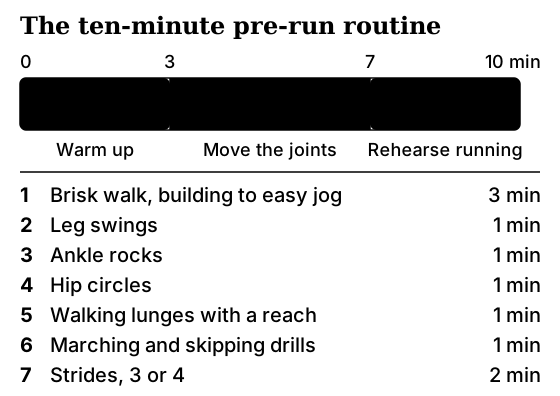
Minutes 0 to 3: raise your temperature
- Brisk walk building to an easy jog (3 minutes). Walk briskly for the first minute, then break into the gentlest jog you can manage, slower than your easy running pace. You should be able to talk comfortably throughout.
Minutes 3 to 7: move the joints running uses
-
Leg swings, front to back (1 minute). Hold a wall or post with one hand. Swing the outside leg forward and back like a pendulum, starting small and letting the range grow. About 10 swings per leg.
-
Ankle rocks (1 minute). Stand facing a wall with one foot a hand’s length away from it. Keeping the heel down, bend the knee forward towards the wall, then straighten. Do about 10 rocks per side. It takes the ankle through the forward bend each stride asks of it.
-
Hip circles (1 minute). Still holding the wall, lift one knee to hip height, open it out to the side, and lower it, as if stepping over a gate. Do 5 per leg, then reverse the direction for 5 more.
-
Walking lunges with a reach (1 minute). Take a long step forward into a lunge, keeping the front knee over the ankle, and reach both arms overhead. Step through into the next lunge. Do about 6 per leg. This works the front of the hips that stiffen after a day of sitting, and wakes up the glutes.
Minutes 7 to 10: rehearse running
-
Marching and skipping drills (1 minute). March on the spot, lifting knees to hip height and swinging your arms, for 20 seconds. Then do 20 seconds of light skips forward, and 20 seconds of quick, small steps on the balls of your feet.
-
Strides (2 minutes). Run about 15 to 20 seconds at a comfortably quick pace, faster than your easy run but well short of a sprint, then walk back. Do 3 or 4. Before an easy run, two strides are plenty.
Then start your run at an easy pace for the first few minutes.
Make it easier: replace the strides with an extra two minutes of easy jogging, and do the lunges without the overhead reach. Make it harder: add 5 slow single-leg calf raises per side after the ankle rocks, and make the last stride your target race pace.
Afterwards: a four-minute wind-down
There is no clear injury benefit here either, but many runners like a calm finish, and stretching after a run does increase range of motion for a while. Keep holds gentle and around 20 to 30 seconds.
| Move | How | Time |
|---|---|---|
| Walk | Easy pace, to let your breathing settle | 2 minutes |
| Calf stretch | Against a wall, back heel down | About 20 seconds per side |
| Standing quad stretch | Holding a wall for balance | About 20 seconds per side |
| Hip flexor stretch | Kneeling or standing | About 20 seconds per side |
If you spend the rest of the day at a desk, the stiffness you feel the morning after a long run often has more to do with sitting than with the run. Our 10-minute daily mobility routine is built for those days and pairs well with this one.
Fitting it into real running life
The routine is designed to survive real schedules. A nurse who runs after a night shift, when her legs feel heavy and her joints stiff, might stretch block one to five minutes and skip the strides. A father who squeezes a 30-minute run into his lunch break might do the full ten minutes as the first part of that half-hour, rather than treating it as extra. A newer runner preparing for a first 10K might do the full routine before the weekly faster session and just the walking and leg swings before easy runs.
If your schedule only allows one change, put strength work into the week before adding more stretching. Two short sessions of squats, lunges, calf raises and hip bridges are where the injury evidence is strongest.
When to see a professional
Mobility drills should feel easy and free. See a doctor or physiotherapist if you have pain that makes you change how you run, pain that is worse the morning after each run, swelling, pain in a specific spot on a bone, or any pain that stays with you for more than a week or two. A physiotherapist who works with runners can also look at your training load, which is often the real cause of overuse injuries.
The wise move
Before your next run, set a ten-minute timer on your phone at the front door and do the routine on the pavement or in the hallway. Only start your watch's run tracking when the timer goes off.
Questions people ask
Should I do this routine before an easy run or only before hard sessions?
Before hard sessions, intervals and races it is most useful, because those ask more of your muscles from the first minute. Before a very easy run, the first few minutes of the run itself can serve as the warm-up, and the drills are optional.
I run first thing in the morning and feel stiff. Do I need longer?
Many runners feel stiffer early in the day. Lengthen the first block of brisk walking or easy jogging to five minutes rather than adding extra stretches.
Can I use a foam roller instead?
A short spell of rolling feels good to many people and is fine to add, but it is not a substitute for warming up by moving, and it has not been shown to prevent running injuries.
Sources
- Interventions for preventing lower limb soft-tissue running injuries — Cochrane Database of Systematic Reviews (Yeung, Yeung & Gillespie), via Europe PMC, 2011
- The effectiveness of exercise interventions to prevent sports injuries: a systematic review and meta-analysis of randomised controlled trials — British Journal of Sports Medicine (Lauersen, Bertelsen & Andersen), via Europe PMC, 2014
- Effects of warming-up on physical performance: a systematic review with meta-analysis — Journal of Strength and Conditioning Research (Fradkin, Zazryn & Smoliga), via Europe PMC, 2010
- Acute effects of muscle stretching on physical performance, range of motion, and injury incidence in healthy active individuals: a systematic review — Applied Physiology, Nutrition, and Metabolism (Behm et al.), 2016
This article is general information, not medical advice. Talk to a doctor or qualified professional about your own situation. Read how we work in our editorial standards.
Keep moving
More in Body →
A 10-minute daily mobility routine for desk days
A gentle 10-minute routine for neck, shoulders, back and hips on days you sit a lot, with clear steps, timings and honest notes on what the evidence supports.

Movement snacks: why short bursts of activity add up
Short bursts of movement spread through the day count for your health. What the research says about movement snacks, and how to fit them into a busy life.

Walking for mental health: why a daily walk is a wise move
What research says about walking, mood, depression and anxiety, how much seems to help, and how to turn a daily walk into a habit that supports your mind.