Idea
Seneca on anger summary: what the three books argue, and what still holds
A Seneca On Anger summary, book by book: his case that anger is never useful, how it starts in the mind, his remedies, key passages, and what modern research supports.

In On Anger, Seneca argues that anger is a short madness that is never useful, not even in war or justice. Book I makes that case, Book II explains that anger only takes hold once the mind agrees it has been wronged, and Book III gives remedies for avoiding anger, stopping it and calming other people. His practical advice holds up better than his claim that anger can be removed entirely.
Key takeaways
- Seneca wrote On Anger for Novatus, who had asked him how anger could be soothed.
- He rejects Aristotle's idea that anger can serve courage, as long as reason stays in command.
- The work separates an involuntary first jolt from the moment you agree that you were wronged and should strike back.
- Much of Book III is about prevention: lighter workloads, calmer company, and not arguing while tired or hungry.
- A modern sleep study and a large review of anger management fit parts of his advice; his physical theory of temperament does not survive.
Seneca’s On Anger is one of the oldest self-help books still in print, and one of the least read from start to finish. People know a line or two, usually the one about delay. The whole work is stranger and more ambitious: three books that try to prove anger is useless, explain how it gets a grip on the mind, and then teach you to live without it.
This page walks through what Seneca argues in each book, the passages worth knowing, and which parts survive contact with modern psychology. Quotations come from Aubrey Stewart’s public-domain translation of 1900, with book and chapter numbers. If you want exercises rather than a summary, our page of Stoic exercises for anger turns the advice into steps.
The setting: a brother’s request
The work opens with Seneca answering his brother: “You have demanded of me, Novatus, that I should write how anger may be soothed” (Seneca, Of Anger I.1, Stewart translation). It reads like a reply to someone who wanted relief: long arguments, then sudden practical turns, then a story about a tyrant.
It also sits inside a bigger system. Our guide to Stoicism for everyday life covers the Stoic idea that destructive emotions rest on judgments. On Anger is that idea applied, at length, to one emotion.
Book I: anger is never worth having
Book I is the case for the prosecution. Seneca agrees with “some of the wisest of men” that anger is “a short madness” (I.1): deaf to advice, set off by trifles, careless of itself as long as it hurts someone else. Part of the opening is lost, but a later writer, Lactantius, preserved Seneca’s definition: anger is “the desire of avenging an injury” (footnote to I.2). Seneca notes that Aristotle’s version, “a desire to repay suffering”, differs little from his own (I.3).
His big opponent is also Aristotle, who thought anger was necessary in a fight, provided it served “not as a general, but as a soldier” (I.9). Seneca’s reply is the backbone of the book. Anger that obeys reason is no longer anger, and anger that does not obey cannot be trusted. Courage does not need it: “No man becomes braver through anger, except one who without anger would not have been brave at all” (I.13).
The same goes for justice. “A good judge condemns wrongful acts, but does not hate them” (I.16). Seneca’s warning example is the governor Gnaeus Piso, who ordered a soldier executed for returning without his comrade, then, when the comrade walked into camp alive, had both men killed, plus the centurion who brought them back. “Because one was proved to be innocent, two perished” (I.18).
A modern version is smaller but recognisable. Hannah, a team leader, wants to discipline a junior colleague who missed a deadline. Seneca would not tell her to let it go. He would tell her to decide the consequence after the heat has gone, because anger, like Piso, hates being proved wrong.
Book II: anger needs your agreement
Book II asks how anger starts, and this is where Seneca is most original. The Stoic view, he says, is that anger “can venture upon nothing by itself, without the approval of mind” (II.1). Some reactions really are involuntary, such as “shivering when cold water is poured over us” (II.2). Those are not yet anger.
He then lays out three movements (II.4). The first emotion “is involuntary”, a preparation for a passion. The second is a wish that still listens to reason: “It is my duty to avenge myself, because I have been injured.” The third “overrides reason” and wants revenge whether or not it is right. The Stanford Encyclopedia of Philosophy describes this as a distinction between involuntary “proto-emotions” and full emotions, which involve assent and are therefore within our power.
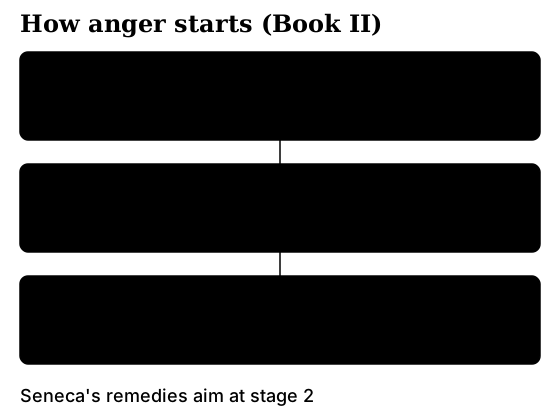
The rest of Book II argues from that sequence. “The cause of anger is the belief that we are injured; this belief, therefore, should not be lightly entertained” (II.22). Seneca says to let time pass, because “time discloses the truth”, and to “plead the cause of the absent against ourselves”. He also points out how selective we are: “We have other men’s vices before our eyes, and our own behind our backs” (II.28).
Picture Daniel, who sees a friend’s photo from a dinner he was not invited to. The sting arrives on its own; that is stage one. The sentence “they left me out on purpose” is stage two, and it is the one he can question. There may have been a work dinner, a small table, a reason he cannot see.
Book II also widens the frame. Being angry at people for doing wrong, Seneca argues, is like being angry at children for being children, and “to be a human being is a greater and a better excuse than to be a child” (II.10).
Book III: avoid it, stop it, calm it in others
Book III sets out three aims: “the first thing is not to be angry, the second to lay aside our anger, and the third to be able to heal the anger of others” (Of Anger III.5).
Prevention gets the most space. Do not take on more than you can manage, and “first form an estimate both of your own powers” (III.7). Spend time with “straightforward, good-natured, steady people” (III.8). Avoid exhaustion, hunger and thirst, because “a weary man is quarrelsome” (III.9). His sharpest line: “Anger often comes to us, but we often go to it” (III.12). And if you know your weak spots, “prepare obstacles beforehand” (III.13), as guests who cannot hold their wine ask to be led home early.
Then come the horror stories: Cambyses shooting his adviser’s son through the heart to prove his hand was steady after drinking (III.14), Harpagus served his own children at dinner (III.15). They are there to show what unchecked anger does with power, and to make a grimmer point: even rage at an outrage can be hidden when survival depends on it. Book II gives a Roman example, a father who dined with the emperor Gaius on the day his son was executed (II.33).
The evening review, where Seneca passes “the whole day in review before myself” (III.36), comes near the end. For calming other people, his advice is to wait: “You should not attempt to allay the first burst of anger by words: it is deaf and frantic” (III.39). The book closes on mortality. Life is short, so “while we live among human beings, let us practise humanity” (III.43).
What holds up today, and what does not
Some of Seneca’s prevention advice has modern support. In a 2019 experiment, 142 adults were randomly assigned to keep or restrict their sleep over two days, and sleep restriction intensified anger during an irritating task (Krizan & Hisler, 2019). That is close to his warning about weariness.
His preference for calming down over letting anger run also fits the evidence. A 2024 meta-analysis of 154 studies with about 10,000 participants found that activities which lower arousal, such as slow breathing and meditation, reduced anger and aggression, while arousal-raising ones, such as hitting a bag or jogging, were ineffective overall (Kjærvik & Bushman, 2024). Neither study tested Seneca’s methods directly, so treat this as a fit rather than proof.
Other parts have aged badly. Book II explains temper through heat and moisture in the body (II.19), a theory no one holds now. And his central claim, that anger should be removed rather than moderated, is still disputed. Many readers side with Aristotle that some anger at injustice is appropriate, even if they borrow Seneca’s techniques for keeping it in check. A useful middle position is to keep the judgment that something was wrong, and drop the demand for payback, which is close to the line our page on the dichotomy of control draws between what you can act on and what you cannot.
If anger in your own life is frequent, frightening to people around you, or has turned physical, a GP or therapist is a better next step than any ancient text.
Reading it yourself
Stewart’s translation is free to read online, one page per book. Start with Book III, return to Book II for the theory, and read Book I last, when you already know which of Seneca’s arguments you want to argue with.
The wise move
The next time you feel wronged, write down the exact words of the thought, 'they did this to me on purpose', then add one line Seneca would ask for: what an innocent explanation would look like.
Questions people ask
Which book of On Anger should I read first?
Book III if you want practical advice, since it holds the remedies, the evening review and the advice on calming others. Book II is the one to read for the theory of how anger begins, and it is shorter on stories.
Is On Anger the same work as De Ira?
Yes. De Ira is the Latin title. Older English translations, such as Aubrey Stewart's of 1900, call it Of Anger, and it is often printed among Seneca's dialogues.
Did Seneca think anger could be justified by a real injustice?
No. He holds that a good person can defend others, punish wrongdoing and avenge a parent without anger, using reason alone. That is the point where many modern readers part company with him.
Sources
- Of Anger (De Ira), Book I, by Seneca (translated by Aubrey Stewart, 1900) — Wikisource, 1900
- Of Anger (De Ira), Book II, by Seneca (translated by Aubrey Stewart, 1900) — Wikisource, 1900
- Of Anger (De Ira), Book III, by Seneca (translated by Aubrey Stewart, 1900) — Wikisource, 1900
- Seneca (Katja Vogt) — Stanford Encyclopedia of Philosophy, 2024
- Sleepy anger: Restricted sleep amplifies angry feelings — Journal of Experimental Psychology: General (Krizan & Hisler), 2019
- A meta-analytic review of anger management activities that increase or decrease arousal: What fuels or douses rage? — Clinical Psychology Review (Kjærvik & Bushman), 2024
Read how we work in our editorial standards.
Keep moving
More in Philosophy →
Stoic exercises for anger: 8 practices from Seneca, Epictetus and Marcus
Stoic exercises for anger, taken straight from Seneca's On Anger, Epictetus and Marcus Aurelius: step-by-step practices, when to use each, and everyday examples.

Stoicism for everyday life: 7 practices that still work
A plain-English guide to Stoicism: what Epictetus, Seneca and Marcus Aurelius actually taught, seven practices you can use today, and what the evidence says.

The dichotomy of control: stop worrying about what you can't change
Epictetus's oldest piece of advice, explained: how to sort what is up to you from what is not, why it eases worry, and what modern research adds.