Practice
What to do during a panic attack in public: a step-by-step plan
What to do during a panic attack in public: a calm plan for the moment, simple words to say to people nearby, what to do afterwards and when to see a doctor.
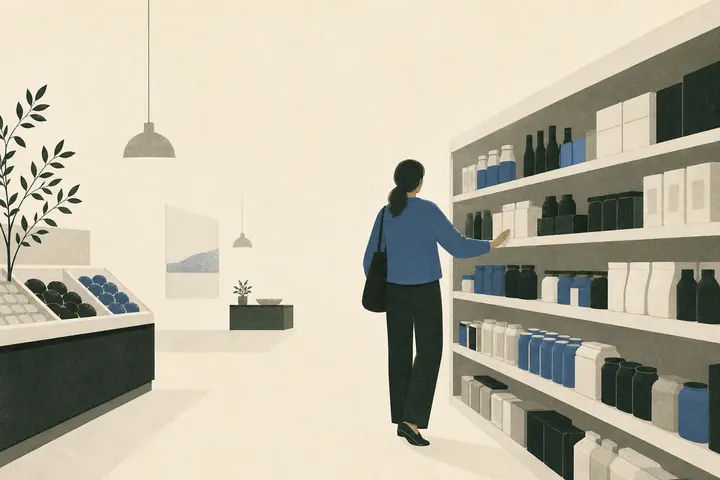
Move a few steps to somewhere you can stand or sit still, such as a wall, a bench or a quieter corner, rather than fleeing the place. Slow your breathing with a long, gentle exhale, ground yourself by naming what you can see and feel, and remind yourself that panic peaks and passes, usually within minutes. If someone asks, a short sentence such as 'I'm having a panic attack, it will pass, I just need a minute' is enough.
Key takeaways
- Panic attacks feel dangerous but are not, according to the NHS; most last somewhere between five and twenty minutes.
- Staying where you are, if you can, teaches your brain that the place is survivable. Running away tends to make the next visit harder.
- Prepare a one-line script for strangers and a 'panic card' in your phone before you need them.
- Chest pain that is new, crushing, spreading or does not ease needs urgent medical help, even if you have had panic attacks before.
A panic attack at home is frightening. A panic attack in a supermarket aisle, on a packed bus or in the middle of a work event adds a second fear: that everyone is watching, and that you will lose control in front of them.
You will not be the first person it has happened to in that place, and you can get through it. This page gives you a plan for the few minutes it lasts, words to use with people around you, and what to do once it has passed.
What is happening in your body
A panic attack is a sudden rush of intense fear with strong physical symptoms. The NHS lists a racing heart, sweating, trembling, shortness of breath, a choking feeling, dizziness, chest pain, pins and needles, a churning stomach, feeling disconnected from your body and a fear of dying. It can come on quickly and for no obvious reason.
The US National Institute of Mental Health notes that some researchers think of panic attacks as false alarms: the body’s survival system firing when there is no real danger. Someone notices their heart pounding, reads it as a heart attack, and that fear drives the symptoms higher. Breaking that loop is what the steps below are for.
The NHS is clear that although panic attacks are frightening, they are not dangerous and will not cause you physical harm. Most last between five and twenty minutes. Knowing that in advance matters, because “this will pass” is much easier to believe when you have read it calmly first.
Your plan for the moment
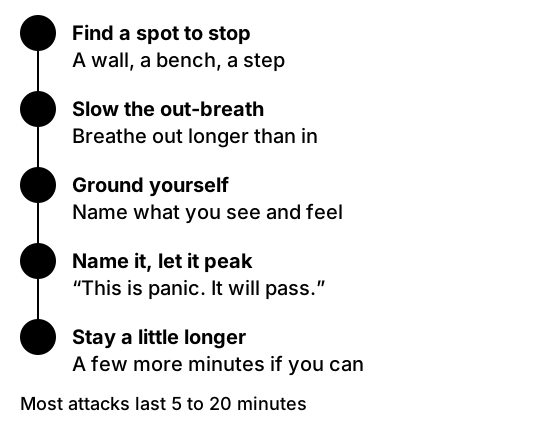
1. Find a spot to stop
Move a short distance to somewhere you can be still: lean against a wall, sit on a bench or a step, stand at the end of an aisle, or step just outside the door. You do not need to get home. The NHS advice for a panic attack begins with staying where you are, if possible.
Lena felt it start in the middle of a busy shopping centre. Instead of heading for the car park at a run, she walked to a bench by a shop window and sat down. That small decision kept her safe and meant she was still in the centre when the panic faded.
2. Slow the out-breath
Panic speeds your breathing up, and fast breathing feeds dizziness and tingling. Breathe in gently through your nose, then let the out-breath be slow and longer than the in-breath. The NHS breathing exercise for stress, anxiety and panic uses a steady count of up to five in and five out; go shorter if five feels impossible. Do not try to take huge breaths. Our practice on breathing to calm down has more techniques to rehearse before you need them.
3. Ground yourself in what is around you
Give your attention a job outside your body. NHS inform suggests noticing five things you can see, four you can feel, three you can hear, two you can smell and one you can taste. In public this is invisible: read the labels on a shelf, feel the cold of a handrail, listen for a specific sound.
4. Name it and let it peak
Tell yourself, silently or in a whisper: “This is panic. It is not dangerous. It will peak and then it will pass.” Fighting the sensations or trying to force them away usually makes them louder. Picture it as a wave you are letting rise and fall rather than something you must stop.
Kwame, who gets panic attacks on his commuter train, counts station announcements as a way of marking time. By the second or third stop, the worst has usually passed, and having seen it pass before makes the next one less frightening.
5. Stay a little longer
When the symptoms ease, stay a few more minutes if you can rather than leaving immediately. Finishing your shop or staying on the bus for one more stop shows your brain that the place was not the danger. Our guide to understanding anxiety explains why avoidance tends to make anxiety grow, and why small steps back towards a feared place help it shrink.
What to say to people around you
You do not owe anyone an explanation, but a short one can stop well-meaning people from crowding you. Prepare one sentence and keep it simple:
- “I’m having a panic attack. It’ll pass. I just need a minute.”
- “I’m OK, I’m just feeling anxious. Could you stay nearby for a moment?”
- “Could you help me find somewhere to sit?”
Most people respond kindly. If someone insists on calling for help and you are sure it is panic, you can thank them and say you will let them know if you need it. If you are not sure, let them call.
When it might not be panic: chest pain and other warning signs
Panic attacks can cause chest pain, and so can heart problems. The NHS chest pain guidance says to call an ambulance if you get sudden chest pain or pressure that does not go away, pain that spreads to your arm, neck, jaw, stomach or back, or chest pain with sweating, nausea, light-headedness or shortness of breath. In any country, call your local emergency number in those situations.
Having had panic attacks before does not rule out something else. If the symptoms feel different from your usual panic, or you are simply unsure, get urgent help. It is far better to be checked and reassured than to wait.
Afterwards
Once it has passed, you will probably feel shaky and drained. That is normal.
- Drink some water and, if you can, eat something small.
- Take a short, easy walk if you feel up to it. Gentle movement helps many people settle; our page on walking for mental health explains why.
- Message someone you trust, even just to say “had a panic attack, I’m OK now”.
- Later, jot down where you were, what happened just before, and what helped. Patterns are useful to you and to any professional you see.
When to see a GP
The NHS recommends seeing a GP if you have been having symptoms of panic disorder. That includes repeated attacks, worrying about the next one, or starting to avoid places because of them. A doctor can check for physical causes and talk through treatment. Talking therapies based on cognitive behavioural therapy are a main treatment for panic disorder and can teach you to change how you respond during an attack. In the UK, adults can refer themselves to NHS talking therapies; elsewhere, start with your family doctor.
If panic comes with thoughts of harming yourself, or you feel unable to keep yourself safe, go to our crisis help page now.
Rehearse the plan before you need it
The steps above are simple, but panic makes simple things hard to remember. Read them once more today, choose your one-line script, and practise the slow out-breath somewhere ordinary, such as at a bus stop or in a queue, so it is already familiar.
The wise move
Open the notes app on your phone now and write a three-line panic card: 'This is panic. It peaks and passes. Breathe out slowly and name five things I can see.' Pin it where you will find it fast.
Questions people ask
Should I leave the place where the panic attack started?
If you are safe, try to stay or move only a short distance, then return when it eases. Leaving every time teaches your brain that the place was the danger, and that is how avoidance spreads. If you must leave, go back for a short visit soon afterwards.
Is it all right to take something to calm me down?
Only medicines prescribed for you, used as your doctor advised. Alcohol and other substances can bring short relief but tend to make anxiety worse over time. Talk to a GP about longer-term options.
How can a friend help if I have a panic attack while we are out?
Tell them in advance what helps you. Usually that is staying close, speaking calmly, breathing slowly with you and not crowding you or asking lots of questions. They should call for help if you have chest pain or they are unsure.
Sources
- Panic disorder — NHS, 2026
- Panic Disorder: What You Need to Know — National Institute of Mental Health (NIMH)
- Chest pain — NHS, 2023
- Breathing exercises for stress — NHS, 2026
- Grounding exercises — NHS inform (NHS 24, Scotland), 2025
This article is general information, not medical advice. Talk to a doctor or qualified professional about your own situation. Read how we work in our editorial standards.
Keep moving
More in Mind →
Anxiety: what it is, what helps, and when to get support
A calm, evidence-based guide to anxiety: why it happens, how ordinary worry differs from an anxiety disorder, what helps day to day, and when to seek support.
How to calm down fast: breathing techniques that work
Three simple breathing techniques you can use in minutes when stress spikes, what the research actually shows, and how to make them part of your day.
Walking for mental health: why a daily walk is a wise move
What research says about walking, mood, depression and anxiety, how much seems to help, and how to turn a daily walk into a habit that supports your mind.