Practice
Premeditatio malorum: how to practice the Stoic rehearsal calmly
Premeditatio malorum, how to practice it step by step: what Seneca and Epictetus wrote, a ten-minute rehearsal, how it differs from worrying, and when to stop.

Choose one real event coming up, name two or three specific things that could go wrong, and ask honestly how bad each would be and for how long. Then decide what you would do if each one happened, and finish by turning back to today. Keep it to about ten minutes, once per event: the aim is a plan and a steadier mind, not a longer list of fears.
Key takeaways
- Seneca told a friend facing a lawsuit to picture the worst outcome and then measure it, expecting the fear to shrink under inspection.
- Worry circles without an exit; the Stoic rehearsal is bounded, concrete and ends in a decision.
- Research on mental contrasting suggests picturing obstacles helps most when it is joined to an if-then plan.
- Defensive pessimism works for some anxious people and not for others, so judge the practice by how you feel afterwards.
Most of us already imagine what might go wrong. We just do it badly: at two in the morning, in loops, with no ending. The Stoics had a name for doing it on purpose and doing it well. Premeditatio malorum, roughly “thinking about troubles in advance”, is a short, deliberate rehearsal of a difficulty before it arrives, so that it meets a prepared mind rather than a startled one.
This page is about the practice itself: what the ancient texts actually say, a step-by-step version you can do in about ten minutes, and the line between rehearsal and plain worry. If you are new to the philosophy behind it, start with our guide to Stoicism for everyday life.
What Seneca and Epictetus actually wrote
The Latin phrase is a later label, but the idea runs through Seneca’s letters. Writing after a fire had destroyed the city of Lyon, he argued that a sudden disaster hits hardest because it is unexpected: “Our minds should be sent forward in advance to meet all problems,” and “we should consider, not what is wont to happen, but what can happen” (Seneca, Letter 91.4, Gummere translation).
The most practical version is in Letter 24. His friend Lucilius is anxious about a lawsuit. Seneca does not reassure him that it will be fine. He tells him to assume the feared outcome will happen, then to “measure it in your own mind, and estimate the amount of your fear”. His expectation is that the fear will turn out to be about something “either insignificant or short-lived” (Seneca, Letter 24.2, Gummere translation).
Epictetus put it more starkly: “Let death and exile and every other thing which appears dreadful be daily before your eyes” (Epictetus, Enchiridion XXI, Long translation). His reason was not to frighten himself. It was that someone who has already looked at the worst will not be ruled by petty desires or panic.
Notice what these passages share: the point is to look at the difficulty clearly, size it, and get ready. Nobody is told to dwell.
The rehearsal in five steps
Set aside about ten minutes, ideally in daylight and with a pen.
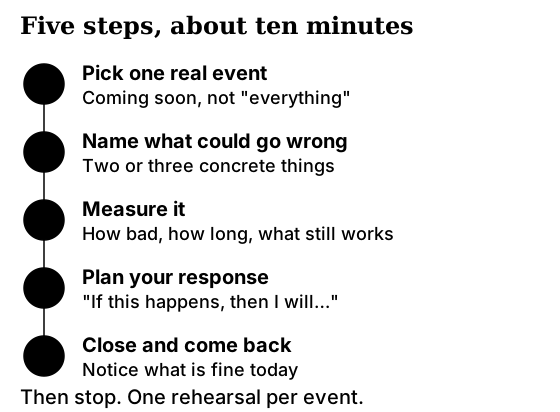
1. Pick one real event
Choose something specific and near: a performance review on Thursday, a long-haul flight with two small children, a first Christmas at your partner’s parents’. “Everything that could go wrong this year” is too big to rehearse; it only feeds dread.
2. Name two or three concrete setbacks
Write them as events, not feelings. Not “it will be a disaster” but “the connecting flight is delayed”, “the toddler screams through take-off”, “the buggy gets lost”. Two or three is plenty. If you find yourself writing a seventh, you have tipped into worry.
3. Measure each one, as Seneca suggested
For each setback, ask: if this really happened, how bad would it be, and for how long? What would still be working? Marta, flying alone with two children, writes that a lost buggy would mean an awful hour at the airport and a borrowed pushchair from her sister on arrival. Written down, it is unpleasant and finite. That shrinking is exactly what Seneca was pointing at.
4. Decide your response
Turn each setback into a plan: “If the connection is delayed, I will go straight to the desk and ask about the next flight before the queue forms.” “If the toddler screams, I will walk the aisle with her and let the looks go.” Some parts will not be up to you at all; our page on the dichotomy of control is a good companion for sorting those out.
5. Close and come back
End by looking at what is fine right now: the tickets are booked, the children are asleep, today is ordinary. Then stop. One rehearsal per event is enough. If the same event comes back to mind later, remind yourself that it already has a plan.
Rehearsal is not the same as worrying
From the inside, worry and rehearsal can feel alike. The difference is in the shape.
Worry is repetitive, open-ended and vague. It asks “what if?” and never answers. A large review of research on repetitive thought found that dwelling on problems can be harmful or helpful, and that one of the things separating the two is how abstract or concrete the thinking is. Abstract, evaluative thinking about upsetting events tended to go with worse outcomes, while concrete thinking was linked to useful things like preparation and planning (Watkins, Psychological Bulletin, 2008).
Catastrophising goes one step further: it jumps to the worst case and treats it as certain. Seneca warned against exactly that. He told Lucilius that “we suffer more often in imagination than in reality”, advised him “not to be unhappy before the crisis comes”, and asked him to check “whether your proofs of future trouble are sure” (Seneca, Letter 13, Gummere translation). A Stoic rehearsal tests the fear; catastrophising feeds it.
Dev, a junior designer, used to spend the week before a performance review imagining his manager’s disappointed face. When he tried the five steps instead, the realistic setbacks were “she says my last project overran” and “she does not mention promotion”. He wrote what he would say to each and a question to ask. The review still made him nervous, but the week before it was quieter.
What psychology adds
Two lines of research fit the practice, with caveats.
Defensive pessimism. In studies by Julie Norem and Nancy Cantor, some anxious people coped with risky situations by setting low expectations and thinking through what might go wrong. Their anxiety did not become debilitating, and when researchers interfered with this strategy, their performance got worse (Norem & Cantor, 1986). That suggests rehearsal can be a sensible strategy for naturally anxious people, not a flaw to be cheered out of them. Picture a colleague who always predicts the presentation will flop, then quietly prepares an answer to every awkward question: telling her to cheer up may help less than leaving her method alone. It does not mean everyone should adopt it.
Mental contrasting with implementation intentions. This technique asks people to picture a goal, then the obstacles in the way, then make an if-then plan for each obstacle. A 2021 meta-analysis of 21 studies with nearly 16,000 participants found a small-to-medium effect on reaching goals, and the authors noted possible publication bias, meaning the true effect may be smaller (Wang, Wang & Gai, Frontiers in Psychology, 2021). It is a close modern cousin of step 4: imagining obstacles seems most useful when it ends in a plan.
Premeditatio malorum itself has not been tested as a formal technique. Treat the research as a reason to keep the plan step, not as proof the ancient version works.
When to stop
The practice is meant to steady you. Put it down if:
- you feel worse after a rehearsal, not calmer, two or three times in a row;
- it is drifting into bedtime, where overthinking at night tends to take over;
- the event involves grief, illness or a past trauma that rehearsal reopens rather than prepares for;
- you are doing it many times a day, or about things that are not coming up at all.
If worry is hard to control most days, affects your sleep or keeps you from things you need to do, talk to a GP or a therapist rather than adding more Stoic exercises. If you are ever in crisis, our crisis help page lists lines you can call straight away.
One event, one page, one plan
Seneca’s advice to Lucilius fits on a single sheet: look at the thing, weigh it, decide what you would do, and get on with your day. Rehearsal earns its place when the plan is on paper and the rest of the day is left alone.
The wise move
Pick the one event this week you are most uneasy about, set a ten-minute timer, and write a single line for it that starts 'If ___ happens, I will ___.' Then put the pen down when the timer rings.
Questions people ask
Is premeditatio malorum the same as negative visualisation?
They overlap. Modern writers often use 'negative visualisation' for imagining the loss of things you love, which helps gratitude. Premeditatio malorum is usually aimed at a coming difficulty, so it ends in a plan rather than appreciation.
Should I practise it in the morning or the evening?
Earlier is usually better. A rehearsal finished before lunch leaves the rest of the day to act on the plan, while one done in bed tends to slide into ordinary worry.
What if I cannot think of anything I would do?
Then the next step is information, not more imagining: who could you ask, what could you look up, what would you need to know first? Writing that down still counts as a plan.
Sources
- Moral letters to Lucilius, Letter 91 (translated by Richard Mott Gummere) — Wikisource, 1917
- Moral letters to Lucilius, Letter 24 (translated by Richard Mott Gummere) — Wikisource, 1917
- Moral letters to Lucilius, Letter 13 (translated by Richard Mott Gummere) — Wikisource, 1917
- The Enchiridion, by Epictetus (translated by George Long) — Standard Ebooks
- Defensive pessimism: harnessing anxiety as motivation — Journal of Personality and Social Psychology (Norem & Cantor), 1986
- A Meta-Analysis of the Effects of Mental Contrasting With Implementation Intentions on Goal Attainment — Frontiers in Psychology (Wang, Wang & Gai), 2021
- Constructive and unconstructive repetitive thought — Psychological Bulletin (Watkins), 2008
Read how we work in our editorial standards.
Keep moving
More in Philosophy →
Stoicism for everyday life: 7 practices that still work
A plain-English guide to Stoicism: what Epictetus, Seneca and Marcus Aurelius actually taught, seven practices you can use today, and what the evidence says.

The dichotomy of control: stop worrying about what you can't change
Epictetus's oldest piece of advice, explained: how to sort what is up to you from what is not, why it eases worry, and what modern research adds.

How to stop overthinking at night: move the thinking to earlier
Why your mind replays and rehearses at bedtime, and how to stop overthinking at night with a scheduled worry time, a specific to-do list and a plan for in bed.