Practice
Stretches to do before bed for sleep: a 10-minute wind-down
Seven gentle stretches to do before bed for sleep, timed into a 10-minute routine, plus an honest look at what trials of stretching and yoga show for sleep.
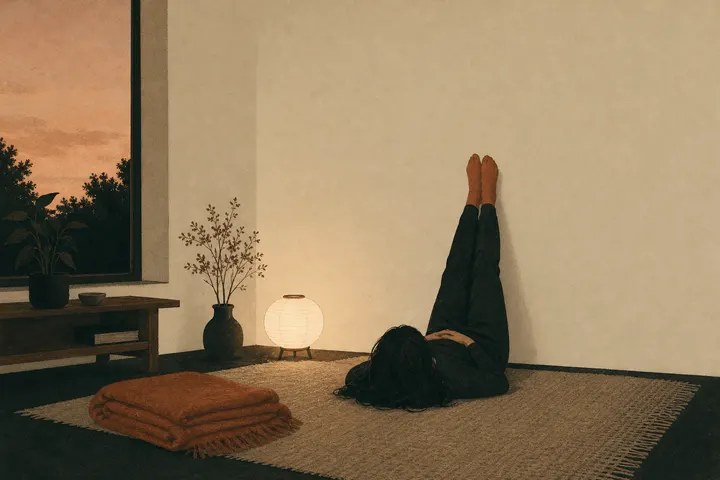
Choose slow, floor-based stretches you can hold while breathing easily: a neck stretch, child's pose, knee hugs, a figure-four hip stretch, a lying twist and legs up the wall. Do them in dim light for about ten minutes during your last hour before bed, at a gentle effort. Trials suggest regular stretching and yoga can modestly improve sleep, but the evidence is small, so treat this as one part of a wind-down rather than a cure.
Key takeaways
- The best-known stretching trial for insomnia used hour-long sessions in the early evening, not bedtime stretches, so the bedtime version is an educated extrapolation.
- Pooled yoga trials in women found a modest gain in self-rated sleep quality, with no clear benefit in some groups, such as women around the menopause.
- Intensity matters more than the exact stretch: easy enough to breathe slowly and talk, never strong enough to make you warm or out of breath.
- Done at the same point every night, a short routine also works as a cue that the day is over.
Some evenings your body arrives at bedtime still holding the day. Shoulders up near your ears from the laptop, hips stiff from the car, a lower back that has been sitting for nine hours. You lie down and it all just sits there, humming.
A few minutes of slow stretching is one of the simplest ways to change that, and it is also one of the most oversold. Below is a routine that takes about ten minutes, followed by an honest look at what the research behind “stretch for better sleep” actually tested.
A 10-minute routine for the last hour of the day
Do this on a rug or a folded blanket, with the main light off and a lamp on. Breathe through your nose if that is comfortable, and let each out-breath be a little longer than the in-breath. Effort should stay low throughout: a mild pull, never a strain.
| Stretch | Time | How to do it |
|---|---|---|
| Slow breathing, sitting | 1 minute | Sit cross-legged or on the bed edge, hands on your belly, and slow your breathing down |
| Side neck stretch | 1 minute | Tip one ear towards that shoulder for 30 seconds, then switch sides |
| Child’s pose | 1 minute | Kneel, sit back towards your heels, fold forward and rest your forehead on the floor or a cushion |
| Knee hugs | 1 minute | Lie on your back, draw both knees towards your chest and rock gently side to side |
| Figure-four hip stretch | 2 minutes | On your back, cross one ankle over the opposite knee and draw both legs in; 1 minute each side |
| Lying twist | 2 minutes | Knees bent, let them fall to one side while your shoulders stay down; 1 minute each side |
| Legs up the wall | 2 minutes | Lie with your bottom near a wall and rest your legs up it, arms loose by your sides |
The order runs from upright to lying down on purpose, so you finish in the position closest to sleep. If you only have three minutes, keep the knee hugs and legs up the wall.
Think of Priya, a ward nurse who gets home from a late shift wired and aching. She used to scroll on the sofa until she felt tired enough. Now she does the last three stretches on her bedroom floor with the lamp on. It does not knock her out, but it gives her body a clear signal that the shift is over, and she finds she reaches for her phone less once she is lying down.
If the breathing part is what helps you most, our comparison of box breathing and 4-7-8 breathing gives you two patterns to use during the holds.
What the trials actually tested
The claim that stretching improves sleep rests on a handful of studies, and their details matter.
The trial most often quoted is a small Brazilian study of 28 adults with chronic insomnia. One group did low-intensity stretching for an hour, three times a week, between 5pm and 6pm, for four months. Compared with a control group, both the stretching group and a resistance-training group improved on an insomnia severity scale, on self-rated sleep quality, and on wrist-monitor measures such as how long it took to fall asleep. The stretching group also reported less tension and anxiety. But overnight lab recordings of sleep showed no clear difference, and the control group was not randomly assigned (D’Aurea et al., Brazilian Journal of Psychiatry, 2019).
So the best direct evidence is for regular, early-evening stretching sessions much longer than ten minutes. A short routine at bedtime has not, as far as we could find, been tested in the same way. It is a reasonable extrapolation, not a proven treatment.
Yoga has more research behind it. A 2020 review pooled 19 studies with about 1,800 women who had sleep problems and found a modest improvement in self-rated sleep quality compared with inactive control groups, with no serious side effects reported. The benefit was not clear in women with breast cancer or in women around the menopause, and three trials that measured insomnia severity found no effect (Wang et al., BMC Psychiatry, 2020).
A 2025 network meta-analysis of 22 trials with about 1,350 people with insomnia went further, ranking yoga among the most promising forms of exercise and suggesting it may add a lot of sleep time. Those figures come with a large caveat: the authors’ own press release notes that 15 of the 22 trials had design flaws, many were small, and the programmes ran for weeks to months (BMJ Group, 2025). Treat the headline numbers as a reason for interest, not a promise.
Why a slow routine may help anyway
Two plausible mechanisms sit behind the evidence, and neither depends on how flexible you are.
The first is lower arousal. Holding an easy position while breathing slowly gives an anxious, busy body something calm to do. That fits with the stretching group in the Brazilian trial reporting less tension.
Take Tom, a delivery driver whose hips and back tighten after a day getting in and out of the van. He used to go straight from the television to bed and lie there feeling every muscle. The figure-four and the twist do not change his hips overnight, but ten minutes on the floor give his attention somewhere quieter to go before he lies down.
The second is routine as a cue. The same short sequence, at the same point every night, becomes part of the signal that the day is closing, much as a regular wake-up time anchors the rest of your sleep. Our guide on how to sleep better covers the habits with the strongest evidence, and stretching fits best alongside them rather than instead of them.
Getting the effort right
The NHS advises relaxing for at least an hour before bed and also says not to exercise within four hours of bedtime (NHS). Those two pieces of advice are compatible as long as bedtime stretching stays at the relaxing end. A good test: you should be able to breathe slowly through your nose and hold a quiet conversation the whole time. If you feel warm, your heart rate rises or you start pushing for a deeper stretch, you have turned it into a workout.
Marguerite, 68, liked a yoga flow video she found online, but its standing poses and quick transitions left her more awake. She kept the lying-down part of the video, held each position a little longer, and dropped the rest.
A few safety notes. Move into and out of each stretch slowly, especially getting up from the floor if you are prone to dizziness. Skip knee hugs and deep twists if they aggravate a back problem, and avoid legs up the wall if a doctor has told you to avoid lying flat. For daytime stiffness, a separate daily mobility routine does more than a bedtime stretch can.
When stretching is not enough
A wind-down routine helps with ordinary restlessness. It is not designed for long-running insomnia. The NHS suggests seeing a GP or doctor if changing your sleep habits has not helped, if you have had trouble sleeping for months, or if poor sleep is making daily life hard to cope with (NHS). See a doctor too if stiffness or pain is what keeps you awake, or if a stretch causes pain, numbness or tingling.
For most nights, though, the aim is modest: ten slow minutes on the floor, a dim lamp, and a body that has been given a chance to let go before you ask it to sleep.
The wise move
Tonight, put a folded blanket on the floor next to the bed before dinner, so that when you go to the bedroom the first thing you meet is the spot where you do two minutes of legs up the wall.
Questions people ask
Can I do these stretches in bed?
Most of them, yes. Knee hugs, the figure-four, the lying twist and a version of legs up the wall against the headboard all work on a mattress. Child's pose is easier on a firm surface, so swap it for knee hugs if your bed is soft.
Is it fine to stretch before bed if I work out in the evening?
Yes. The gentle routine here is closer to a cool-down than a workout. If you trained hard late in the evening, give yourself a little time and a shower first, then stretch once your breathing and heart rate have settled.
Should stretching before bed hurt to work?
No. A mild pull is enough, and at bedtime less is more, because discomfort is the opposite of what you want before sleep. Back off any stretch that pinches, tingles or makes you hold your breath.
Sources
- Effects of resistance exercise training and stretching on chronic insomnia (D'Aurea et al.) — Brazilian Journal of Psychiatry, 2019
- The effect of yoga on sleep quality and insomnia in women with sleep problems: a systematic review and meta-analysis (Wang et al.) — BMC Psychiatry, 2020
- Yoga, Tai Chi, walking and jogging may be best forms of exercise for insomnia (press release on a network meta-analysis in BMJ Evidence Based Medicine) — BMJ Group, 2025
- Insomnia — NHS
This article is general information, not medical advice. Talk to a doctor or qualified professional about your own situation. Read how we work in our editorial standards.
Keep moving
More in Body →
How to sleep better: what the evidence actually supports
Calm, evidence-based guidance on sleeping better: how much you need, which habits matter most, what to do about caffeine and alcohol, and when to get help.
A 10-minute daily mobility routine for desk days
A gentle 10-minute routine for neck, shoulders, back and hips on days you sit a lot, with clear steps, timings and honest notes on what the evidence supports.
How to fall back asleep at 3am: a step-by-step for the moment itself
Awake at 3am and can't drift off again? Why middle-of-the-night waking happens, what to do in the first minutes, when to get up, and when it is insomnia.